
 REQUEST A QUOTE
 EN
 English

Just let we know what you want, and we will get in touch with you as soon as possible!

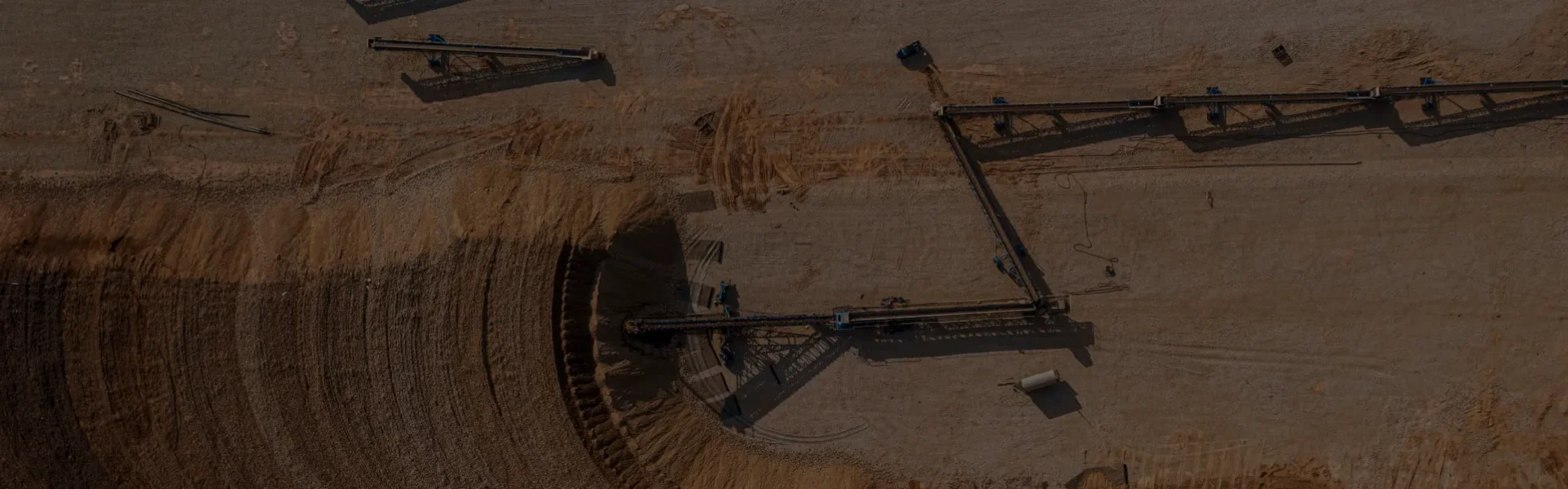
500TPH Mobile Stacking Conveyor System for Gold Ore Heap Leach
A mobile stacking conveyor system was specified for a gold ore heap leach facility requiring a reliable, continuous, and flexible material handling solution. The application involved transferring agglomerated gold ore from the feeding point to a designated stacking area while maintaining a design capacity of 500 tons per hour.
Unlike conventional fixed conveyor installations, the proposed system was designed around mobile conveyor units that could be repositioned as stacking requirements changed. The solution combined a mobile feed conveyor, multiple grasshopper conveyors, and a telescopic radial stacker to create a continuous conveying line with an adjustable discharge point.
The system was developed to accommodate the operational characteristics of agglomerated gold ore, including abrasion, moisture, and material sticking tendencies, while supporting flexible stockpile formation and efficient site operations.
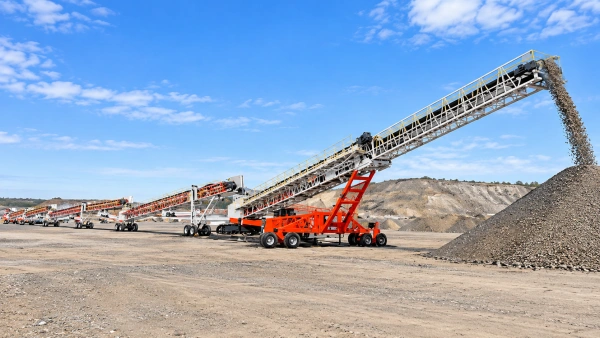
This is a mobible heap leaching stacking system for mineral cell building in mining plant.
| Parameter | Specification |
| Application | Gold ore heap leach stacking |
| Material | Agglomerated gold ore |
| Design capacity | 500 TPH |
| Bulk density | 1.5 t/m³ |
| Particle size P80 | 15 mm |
| Maximum particle size | 30 mm |
| Material characteristics | Abrasive, moist, prone to sticking |
| Operating environment | Open-air, continuous operation |
| Conveyor belt width | 800 mm |
| Belt speed | 2.5 m/s |
| Total conveyor configuration | 1 feed conveyor + 10 grasshopper conveyors + 1 radial stacker |
1. Engineering a Mobile Conveying Solution for Heap Leach Operations
Heap leach facilities require a material handling system capable of transporting ore continuously while distributing material across designated stacking areas. As the heap grows, the discharge position must change to maintain an appropriate stacking pattern and utilize the available footprint efficiently.
A conventional fixed conveyor system can provide stable material transportation, but its layout is often restricted by permanent structures and fixed discharge locations. For operations requiring progressive stacking, this limitation can increase the need for additional infrastructure or material repositioning equipment. The proposed mobile stacking conveyor arrangement addressed these challenges through a combination of interconnected conveyor modules.
The system consisted of:
- One mobile feed conveyor equipped with a vibrating feed hopper
- Ten identical mobile grasshopper conveyors
- One telescopic wheel-mounted radial stacker
The conveyor units were designed to connect in series, forming an uninterrupted material transportation route from the feed point to the final discharge location.
This modular configuration allows the conveying route to be adjusted according to operational requirements, making it suitable for facilities where stacking positions change during different stages of production.
Rather than relying on one exceptionally long conveyor, the system uses multiple mobile sections to provide transportation distance, positioning flexibility, and adaptability.
2. Mobile Feed Conveyor with Vibrating Hopper
The first stage of the system is a mobile feed conveyor equipped with a vibrating feed hopper.
The feed conveyor serves as the receiving and feeding interface between upstream material handling equipment and the downstream conveyor line. Its hopper is designed to accommodate the incoming agglomerated ore while helping maintain a controlled and consistent material flow. The specified hopper has a minimum capacity of 0.8 m³ and a minimum width of 2,000 mm. A vibrating feeding arrangement helps regulate material discharge and reduces the likelihood of material accumulation within the hopper.
Because the conveyed material is moist and prone to sticking, the hopper incorporates wear-resistant lining or replaceable liner plates. This protects the structural steel from abrasive wear and provides a practical maintenance solution for areas exposed to concentrated material impact.
The feed conveyor is approximately 35 m long, with an adjustable inclination ranging from 3° to 7°. Independent height adjustment at both ends allows the conveyor to be positioned to suit the connection height of the subsequent conveyor section.
The chassis configuration can be selected according to the site layout and transportation requirements.
Key Design Considerations
- Vibrating feed hopper for controlled material feeding
- Minimum 0.8 m³ hopper capacity
- Wide hopper opening to accommodate material flow
- Replaceable wear lining
- Adjustable conveyor inclination
- Independent height adjustment at both ends
- Mobile chassis configuration
The feed section is particularly important when handling agglomerated ore because inconsistent feeding can affect the performance of the entire conveying line.
3. Ten Mobile Grasshopper Conveyors for Long-Distance Material Transfer
To extend the conveying distance between the feeding point and the stacking area, the system incorporates ten mobile grasshopper conveyors, each with a nominal length of 35 m.
Grasshopper conveyors are commonly used in mining, quarrying, bulk material handling, and large-scale stockpile operations where conveying distances need to be extended or modified without constructing permanent conveyor infrastructure.
In this application, ten conveyor units are connected sequentially to create a long conveying route. Each conveyor is designed with a wheel-mounted chassis and a towing arrangement at both ends. This enables the units to be relocated using suitable site equipment, such as a loader or dozer, when the conveying layout needs to be changed.
The conveyors feature an adjustable inclination range of 3° to 7°, with independent height adjustment at both ends. This adjustment capability helps maintain suitable transfer geometry between adjoining conveyor sections.
3.1 Standardized Conveyor Design
All ten grasshopper conveyors are designed to be identical.
Standardization provides several practical advantages for mining operations:
- Interchangeable components across the conveyor fleet
- Simplified maintenance procedures
- Reduced spare parts inventory complexity
- Easier operator training
- Consistent equipment performance
- More efficient replacement of individual conveyor units
For a large conveying system, equipment standardization is more than a manufacturing consideration. It can significantly simplify maintenance planning throughout the operating life of the facility.
3.2 Flexible Conveyor Arrangement
The mobile grasshopper conveyors are designed to form a connected conveying line, with transfer points arranged to maintain continuous material flow.
The overlap distances, transfer chute geometry, and discharge-to-receiving conveyor relationship are important engineering considerations. Properly designed transfer points help reduce material spillage, prevent excessive impact, and minimize the risk of blockages.
The modular conveyor arrangement also provides flexibility for future adjustments. Individual sections can be repositioned to accommodate changes in the stacking area or operational layout without requiring the entire system to be reconstructed.
4. Telescopic Radial Stacker with 25–35 m Boom Length
The final discharge stage is a wheel-mounted telescopic radial stacker designed to distribute agglomerated gold ore over a larger stacking area.
The radial telescopic stacker features an internally extending telescopic boom rather than a conventional fixed-length boom. Its working boom length ranges from 25 m in the retracted position to 35 m when fully extended, providing a 10 m telescoping stroke.
This design combines two important functions:
- Radial rotation to distribute material across different stacking positions
- Telescopic extension to increase or decrease the discharge radius
By combining radial slewing and boom extension, the equipment can adapt its discharge position without requiring the entire conveyor line to be relocated every time the stacking point changes.
4.1 Telescopic Boom Design
The telescopic boom is hydraulically extended and retracted. One of the key technical requirements is that telescoping operation should be possible while material flow continues. This allows the discharge position to be adjusted during operation, reducing the need for unnecessary interruptions to the material handling process.
However, telescopic conveyor design introduces additional engineering challenges compared with a conventional fixed boom.
As the boom extends, the belt path length changes. The belt take-up system must compensate for this variation while maintaining appropriate belt tension throughout the operating range.
The proposed design therefore incorporates an automatic belt take-up arrangement intended to compensate for changes in belt path length during telescoping movement.
The extension mechanism, hydraulic power demand, telescoping speed, and belt take-up arrangement are all important factors in the overall performance of the equipment.
4.2 Radial Slewing and Luffing
The stacker is designed for a minimum radial slewing angle of ±90°, with ±180° available as an optional configuration. Its hydraulic luffing system provides an inclination range of approximately 6° to 22°. At the fully extended boom position of 35 m and an inclination of 18°, the specified minimum discharge height is 12 m.
These operating parameters allow the stacker to form different stockpile geometries, depending on the available stacking area, material characteristics, and operational requirements. The equipment is supported by hydraulic outriggers or stabilizers during operation to improve stability. A hydraulically foldable design is also preferred to facilitate transportation and reduce the overall transport configuration.
5. Designing for Abrasive and Moist Gold Ore
The material handling characteristics of agglomerated gold ore have a significant influence on conveyor design.
The material in this application has a bulk density of approximately 1.5 t/m³, a P80 particle size of 15 mm, and a maximum particle size of 30 mm. Although the particle size is relatively fine compared with many conventional bulk materials, the material is abrasive and moist, with a tendency to stick to conveyor components.
These characteristics create several potential operating challenges:
- Material accumulation on belt surfaces
- Carryback around head and tail pulleys
- Increased wear at transfer points
- Belt tracking problems caused by uneven material distribution
- Material buildup around chutes and hopper surfaces
- Increased maintenance requirements for cleaning equipment
To address these conditions, the conveyor system incorporates multiple cleaning and protection measures.
5.1 Belt Cleaning System
Dual belt scrapers are specified at the head pulley, including primary and secondary scraping arrangements.
These devices are designed to remove material adhering to the carrying surface before it returns along the conveyor's return path. A V-plow tail pulley cleaning device is also specified to help prevent material from accumulating on the return belt and entering the tail pulley area.
Effective belt cleaning is particularly important when handling moist ore because carryback can gradually increase maintenance requirements and affect the reliability of the conveyor system.
5.2 Transfer Point Protection
Skirting and dust sealing are incorporated at feed and transfer points. Transfer chute design should consider the direction, velocity, and volume of incoming material to reduce unnecessary impact and prevent material from accumulating in confined areas.
For sticky materials, transfer points require special attention to chute angles, liner selection, internal geometry, and maintenance accessibility.
The final chute configuration should be designed according to the actual material flow characteristics rather than relying solely on standard chute dimensions.
6. Heavy-Duty Conveyor Components for Continuous Operation
- The conveying system is designed around a belt width of 800 mm and a belt speed of 2.5 m/s, with a minimum design capacity of 500 t/h.
- The conveyor belt specification includes an EP100/800 × 4-ply carcass or equivalent, with a minimum cover thickness of 8 mm on the carrying side and 3 mm on the return side.
- An abrasion-resistant belt grade is specified to accommodate the abrasive characteristics of the ore.
- The carrying idlers use a three-roll troughing arrangement with a minimum trough angle of 30°. This configuration of conveyor roller assemble helps support the material load and maintain the belt profile during conveying.
- Idler bearings are specified with dust- and water-tight protection and labyrinth sealing, helping protect bearing components under open-site operating conditions.
- The drive system uses geared motors with backstop devices to drive the conveyor pulley in the mobile conveyor, while soft starting is provided through a soft starter or fluid coupling.
- These components are selected to support stable conveyor operation and reduce unnecessary mechanical stress during starting.
Equipment Protection and Monitoring
Each conveyor unit is equipped with safety and monitoring devices, including:
- Belt misalignment switches
- Zero-speed sensors
- Pull-cord emergency stop systems
- Guards for rotating components
- Belt cleaning devices
- Tail pulley cleaning devices
These features provide basic operational protection and help identify abnormal operating conditions before they lead to more serious equipment problems.
7. Electrical Control and Sequential Conveyor Starting
A long conveyor system with multiple interconnected units requires coordinated starting and stopping procedures.
The proposed electrical configuration uses a 400 V, three-phase, 50 Hz power supply, with 24 V DC control voltage.
The conveyor drives are electric, with a diesel-hydraulic alternative available for consideration where site power availability or operational flexibility makes it advantageous.
A cascade starting sequence is specified, beginning against the direction of material flow.
This sequence allows downstream conveyors to start before upstream feeding equipment begins delivering material, helping reduce the risk of material accumulation at transfer points.
Interlocking between conveyor units is required to coordinate system operation.
A PLC-based central control system can be incorporated as an option to provide centralized operation, monitoring, and coordinated control of the complete conveying line.
Quick-connect power connections between conveyor units are also specified to simplify installation and relocation.
A common emergency stop circuit along the entire conveyor line provides an integrated safety arrangement.
For facilities operating multiple mobile conveyors, coordinated control is particularly important because the system performance depends on all connected units operating in the correct sequence.
8. Corrosion Protection for Outdoor Mining Environments
The equipment is intended for continuous operation in an open-air environment, with an ambient temperature range of approximately -10°C to +45°C.
The operating environment and the chemical conditions associated with heap leach facilities require careful consideration of corrosion protection.
The specified steel structure coating system includes epoxy-based protection with a minimum dry film thickness of 200 μm.
Surface preparation is specified to Sa 2½ according to EN ISO 8501-1, while fasteners are required to be galvanized.
These requirements help provide protection against environmental exposure and support long-term equipment durability.
The coating system should be selected and applied according to the actual exposure conditions, with particular attention to structural joints, weld areas, exposed edges, and areas where moisture or chemical residues may accumulate.
Proper surface preparation is essential because the performance of a protective coating system depends not only on coating thickness but also on the quality of the substrate preparation and application process.
9. Modular Mobile Stacking: Operational Advantages
The proposed configuration combines mobile feeding, modular conveying, and telescopic radial stacking to provide a flexible material handling arrangement.
9.1 Reduced Dependence on Permanent Infrastructure
Mobile conveyors can be positioned according to the requirements of the stacking operation. This approach may reduce the need for extensive permanent conveyor structures in areas where the stacking layout changes frequently.
9.2 Flexible Conveying Distance
The ten grasshopper conveyor modules allow the conveying route to be configured according to the distance between the feed point and the stacking area. The modular arrangement also provides the possibility of future layout adjustments by repositioning individual units.
9.3 Improved Stacking Flexibility
The telescopic radial stacker provides both radial movement and boom extension. This combination allows the discharge position to be adjusted over a wider operating envelope compared with a fixed-length conveyor with a stationary discharge point.
9.4 Standardized Equipment Fleet
Using ten identical grasshopper conveyors helps simplify equipment management. Common components, interchangeable parts, and standardized maintenance procedures can reduce the complexity of operating a large fleet of mobile conveyor units.
9.5 Continuous Material Handling
The connected conveyor arrangement is designed for continuous operation at a capacity of 500 t/h. Coordinated conveyor starting, transfer point design, belt cleaning, and monitoring systems are important to maintaining reliable material flow throughout the line.
10. A Flexible Solution for Gold Ore Heap Leach Stacking
The mobile stacking conveyor system represents an integrated approach to handling agglomerated gold ore in heap leach operations.
The combination of a vibrating feed hopper, mobile feed conveyor, ten standardized grasshopper conveyors, and a telescopic radial stacker creates a modular material transportation and distribution system.
With a design capacity of 500 t/h, the system is configured to support continuous conveying while providing flexibility in the positioning of the final discharge point. The telescopic radial stacker is particularly important to the overall arrangement. Its 25–35 m boom length, 10 m telescoping stroke, hydraulic luffing capability, and radial slewing movement provide multiple ways to adjust the stacking position as operational requirements change.
At the same time, abrasion-resistant conveyor components, belt cleaning systems, transfer point protection, standardized equipment design, and coordinated electrical controls address the practical challenges associated with abrasive and moist agglomerated ore.
For heap leach facilities where stacking areas evolve over time, a modular mobile conveyor system can provide a practical alternative to conventional fixed conveying arrangements.
The final equipment configuration, transfer point geometry, conveyor overlap distances, stacker working envelope, stockpile capacity, and operating sequence should be finalized through detailed engineering based on the site layout and material handling requirements.
- How To Calculate Mobile Conveyor Belt Tensions
- How To Avoid Mobile Conveyor Skirtboard Problems
- Mobile Conveyor System for Bulk Material Handling
- Using Mobile Conveyors to Simplify Processes
- Solutions for Mobile Conveyor Idler Misalignment
- Components of Mobile Conveyors for Mining & Quarrying

Table of Contents

Leading Mobile Bulk Material Handling Equipment Manufacturer in China. A high-tech enterprise specializing in R&D and manufacturing of stacker conveyors, ship loaders, and bucket wheel reclaimers. We provide comprehensive mobile solutions, including mobile hopper feeders, truck unloaders (surface feeders), and transfer conveyors, alongside high-performance mobile crushing and screening plants for global bulk material processing.
How to Contact
- WhatsApp: +8617821512097
- E-mail: [email protected]
-
 Add: China

