
 REQUEST A QUOTE
 EN
 English
Just let we know what you want, and we will get in touch with you as soon as possible!

Belt Conveyor Roller Material Selection: A Guide for Bulk Material Handling
Introduction
When specifying a belt conveyor system, attention is usually given to belt width, conveying capacity, belt speed, drive power, and structural design. conveyor idler rollers, on the other hand, are sometimes treated as standard components that can be selected largely by diameter and price.
That approach can become expensive, particularly in bulk material handling operations.
A conveyor operating at a seaport, an iron ore mine, a coal-fired power plant, or a quarry does not expose its idlers to the same working conditions. One installation may deal with salt spray and persistent moisture. Another may handle sharp, abrasive rock at high loading rates. A third may run continuously in an environment filled with fine ash or chemically aggressive dust.
These differences make belt conveyor roller material selection an important part of conveyor engineering.
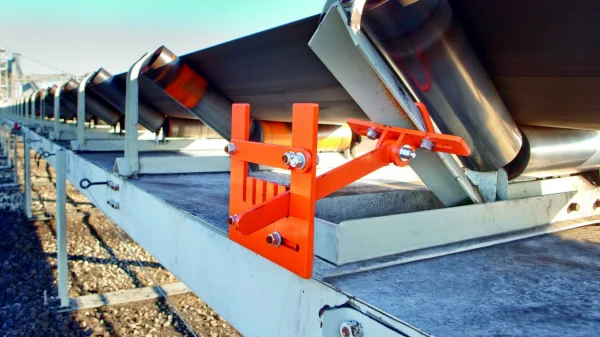
The roller shell must withstand mechanical loading, resist wear, maintain dimensional stability, and remain compatible with the surrounding environment. Its surface condition also affects belt contact, material buildup, rotational resistance, and ultimately conveyor reliability.
There is no single roller material that performs best in every application. Steel remains a proven solution for heavy-duty conveying, while engineered polymer, stainless steel, rubber, and polyurethane offer specific advantages under different operating conditions.
This guide examines the main materials used in bulk material handling conveyor rollers and explains how to select them for ports, mining operations, power plants, aggregate processing, and chemical industries.
1. Why Roller Material Selection Matters in Bulk Material Handling
A conveyor idler roller is more than a rotating tube. It supports the loaded conveyor belt, maintains the required belt profile, and helps control belt movement throughout the conveying system.
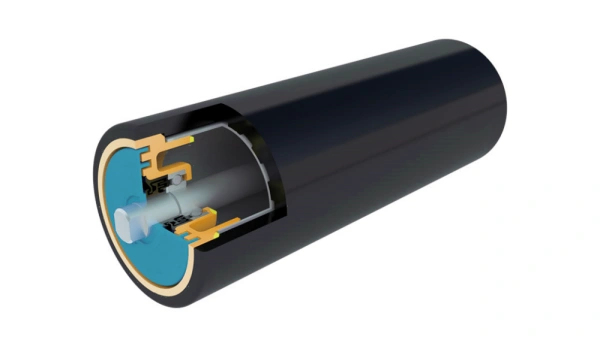
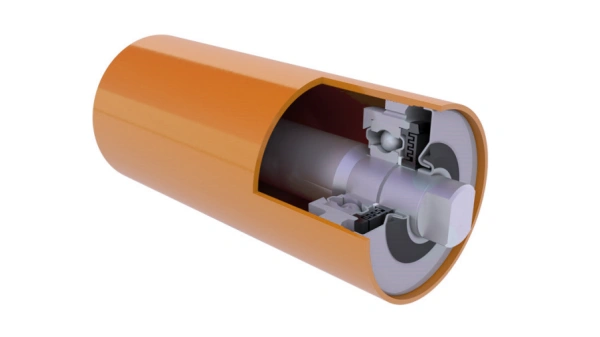
A typical idler roller consists of several important components:
- Roller shell: The main cylindrical body that contacts and supports the conveyor belt.
- Shaft: Transfers the mechanical loads to the supporting idler frame.
- Bearings: Allow the roller to rotate with minimal resistance.
- Bearing housing and end caps: Support and locate the bearings.
- Sealing system: Prevents dust, moisture, and other contaminants from entering the bearing cavity.
- Surface coating or covering: Provides additional protection against corrosion, wear, or material buildup where required.
The shell material is especially important because it determines much of the roller's mechanical and environmental performance.
Consider a conveyor transporting iron ore. The roller surface is continuously exposed to abrasive particles, while the loading section may experience substantial impact from falling material. A lightweight polymer roller might offer advantages in corrosion resistance and handling, but its load capacity and resistance to local deformation must be checked carefully.
Now consider a conveyor transporting fertilizer at a coastal terminal. Corrosion and material buildup may become more important than the extreme impact resistance needed at a mining transfer point.
The difference is not simply a matter of selecting a stronger or more expensive material. It is about matching the roller construction to the actual failure mechanisms expected in service.
2. Common Materials Used for Belt Conveyor Idler Rollers
2.1 Carbon Steel: The Traditional Choice for Heavy-Duty Conveyors
Carbon steel is one of the most widely used materials for bulk material handling conveyor rollers. It provides a practical balance between mechanical strength, stiffness, manufacturing availability, and cost. Steel tube shells can be manufactured in different diameters and wall thicknesses to accommodate different belt widths, support loads, and operating conditions. Its biggest advantage is its ability to maintain structural rigidity under heavy loading.
In mining, quarrying, cement production, and coal handling, rollers may experience continuous loading, vibration, and contact with abrasive particles. A properly designed steel roller can provide reliable support under these conditions, particularly when the shell diameter, wall thickness, shaft, and bearing arrangement are correctly specified.
Main advantages:
- High mechanical strength and structural rigidity.
- Good resistance to bending when properly designed.
- Suitable for heavy-duty and high-load conveyor systems.
- Wide availability of standard tube dimensions.
- Straightforward fabrication, welding, and maintenance.
- Generally economical for large-scale industrial installations.
However, ordinary carbon steel has an obvious weakness: corrosion.
Moisture, salt, chemical fumes, and aggressive process materials can gradually attack an unprotected steel surface. Once corrosion becomes severe, it can reduce shell thickness, damage surface quality, and eventually compromise roller performance.
For this reason, carbon steel idlers are commonly supplied with different protective treatments.
Common steel roller surface protection includes:
- Industrial paint coatings.
- Powder coating.
- Hot-dip galvanizing.
- Epoxy-based protective coatings.
- Polyurethane or rubber coverings.
The choice depends on the severity of the operating environment. A coating that works well in an indoor aggregate plant may not provide sufficient protection for a continuously exposed marine installation.
Another point worth considering is coating damage. In highly abrasive applications, the protective layer can wear away much faster than expected, exposing the underlying steel.
For heavy-duty applications where mechanical strength is the priority, carbon steel remains a dependable starting point. The protection system should then be designed around the actual corrosion and abrasion conditions.
2.2 Stainless Steel: For More Demanding Corrosion Environments
Stainless steel is used when ordinary carbon steel cannot provide the required corrosion resistance. Its chromium-containing passive surface provides corrosion protection, making appropriate stainless steel grades useful in industries handling moisture, certain chemicals, salts, and corrosive process materials.
For conveyor idler rollers, stainless steel can be considered in:
- Fertilizer handling facilities.
- Chemical processing plants.
- Salt production and handling.
- Food-related bulk material processing.
- Wet material conveying systems.
- Special industrial installations requiring improved hygiene or corrosion resistance.
Grades such as 304 and 316 are common starting points for material evaluation.
However, choosing stainless steel should not be treated as an automatic solution to every corrosion problem.
For example, chloride-rich environments, including marine applications, can cause pitting or crevice corrosion depending on the grade, temperature, concentration, and design details. Certain acids and aggressive chemicals may also attack stainless steel.
The bearing housing, shaft, fasteners, and other components must be considered as well. Using a corrosion-resistant roller shell with unsuitable carbon steel end components can create another weak point in the assembly.
Stainless steel also carries a higher material and manufacturing cost than ordinary carbon steel. For this reason, I would generally recommend stainless steel when the process environment justifies it, rather than specifying it throughout an entire conveyor system without evaluating the actual exposure conditions.
2.3 HDPE: A Lightweight Alternative to Steel Rollers
High-density polyethylene (HDPE) has become an increasingly interesting material for belt conveyor idler rollers.
Unlike conventional steel rollers, HDPE rollers use an engineered polymer shell. Their main advantages include lower weight, corrosion resistance, reduced noise, and resistance to many forms of moisture-related deterioration.
These characteristics are particularly useful in installations where corrosion and manual handling are major concerns.
Advantages of HDPE conveyor rollers include:
- Lightweight construction.
- Good resistance to water and many chemical environments.
- Reduced rotational mass.
- Lower operating noise in suitable designs.
- Good impact tolerance for appropriately engineered products.
- Reduced risk of conventional steel rusting.
- Easier handling during installation and replacement.
One practical benefit is the reduction in roller mass.
Large conveyor systems may contain thousands of idlers. Lighter rollers can reduce the weight technicians need to handle during installation and maintenance. Lower rotating mass can also be beneficial when starting and operating a conveyor, although the actual power savings depend on the complete system design.
HDPE also offers advantages where corrosive materials are conveyed. Salt, certain fertilizers, and other moisture-associated materials can create difficult conditions for conventional steel rollers.
There are limitations, however.
HDPE generally has lower stiffness than steel and can deform under sustained loading if the shell construction is not properly designed. Creep, thermal expansion, temperature-related softening, and long-term dimensional stability must all be evaluated.
This is especially important in heavy-duty mining applications where rollers operate under substantial radial loads and continuous mechanical stress.
It would be a mistake to assume that every HDPE roller can directly replace a steel roller of the same dimensions.
The polymer formulation, reinforcement, shell thickness, bearing support, and load rating all influence the actual performance.
For demanding bulk material handling systems, engineered and fibre-reinforced polymer shells may offer improved rigidity and wear properties compared with basic polymer formulations. Product-level testing is still necessary before specifying them for critical high-load positions.
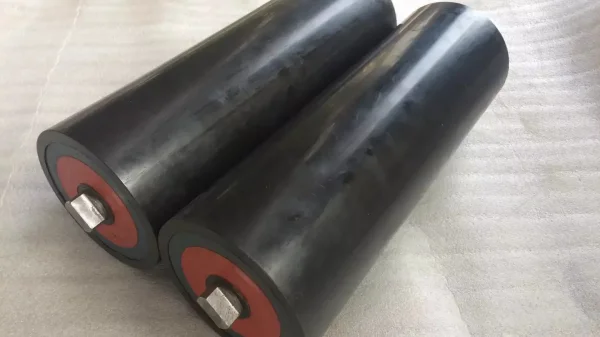
2.4 Nylon (PA6): When Wear Resistance and Stiffness Are Important
Polyamide 6, commonly known as nylon or PA6, is another engineering polymer used in industrial components and conveyor roller applications.
Compared with basic HDPE, PA6 offers different mechanical characteristics, including good strength, stiffness, wear resistance, and thermal performance in suitably engineered formulations.
Its potential applications include industrial conveying systems where reduced weight, wear resistance, and corrosion protection are desirable.
However, nylon has an important characteristic that designers should not overlook: moisture absorption.
PA6 absorbs more moisture than HDPE, and this can affect dimensional stability and mechanical properties. The operating environment must therefore be considered during material selection.
In practice, polymer blends and reinforced composites may be used to balance the advantages of different materials.
For example, combining HDPE with PA6 and suitable reinforcement can help improve certain mechanical and thermal characteristics. The final performance depends heavily on the formulation and manufacturing process.
Nylon should therefore be evaluated as an engineered material rather than simply selected by its generic material name.
For bulk conveyor applications, the supplier should provide relevant load, temperature, abrasion, and environmental performance data for the finished roller.
2.5 Rubber-Covered Rollers: Impact Absorption and Surface Protection
Rubber is commonly used as a roller surface material rather than as the primary structural shell.
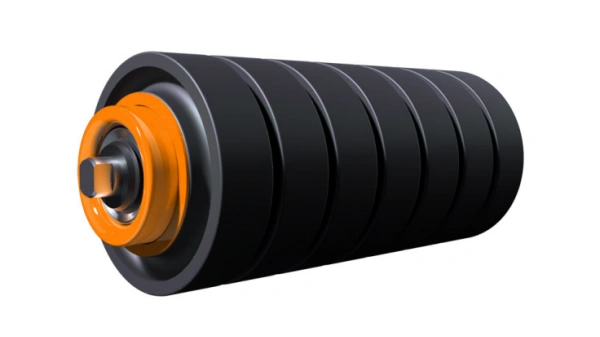
In most bulk material handling applications, rubber rollers are constructed using a steel roller core with rubber rings or a rubber covering on the outside.
Their main purpose is to improve impact absorption, provide a suitable contact surface, and address specific wear or material buildup problems.
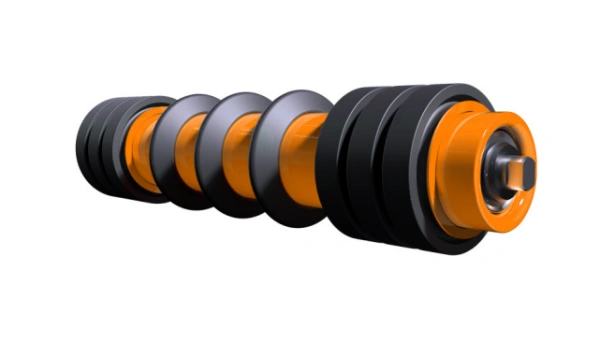
Rubber impact rollers are particularly important around loading and transfer points.
When large lumps of coal, iron ore, granite, or limestone fall onto a conveyor belt, the impact energy can damage the belt and place considerable stress on the supporting idlers.
Rubber impact rings deform under loading and help absorb part of this impact energy. This reduces the severity of direct contact between the falling material, the belt, and the supporting roller structure.
Rubber-covered rollers are commonly used for:
- Conveyor loading zones.
- Transfer points.
- Heavy lump material handling.
- Impact-prone conveyor sections.
- Applications requiring additional cushioning.
Rubber also has applications on the return side of conveyors.
For example, rubber disc return rollers can help limit material buildup and maintain more consistent belt contact when sticky or wet material remains attached to the belt after discharge.
The rubber compound must be selected carefully.
Hardness, elasticity, abrasion resistance, temperature, and chemical compatibility all influence performance. A compound suitable for abrasive mineral handling may not be suitable for hot materials or oil-contaminated environments.
Rubber coverings can also suffer from cracking, hardening, and detachment if the material formulation or bonding process is unsuitable.
2.6 Polyurethane (PU): Wear Resistance and Anti-Buildup Performance
Polyurethane is widely used as a specialized surface material for industrial conveyor rollers.
It is particularly attractive when the main problems are abrasive wear, corrosion, noise, or material accumulation.
Compared with conventional rubber compounds, appropriately formulated polyurethane can provide excellent abrasion resistance and good resistance to repeated surface contact.
Polyurethane-coated rollers can be used where material tends to stick to the roller shell or where corrosion protection is required.
Typical application areas include:
- Fertilizer conveyors.
- Chemical material handling.
- Wet bulk material conveyors.
- Return-side rollers exposed to carryback.
- Industrial conveying systems requiring additional surface protection.
One advantage of polyurethane is that its properties can be adjusted through formulation.
Hardness, elasticity, abrasion performance, and chemical resistance can be tailored to meet different application requirements.
This makes PU a versatile option, but it is important to distinguish between different polyurethane compounds. Not every PU formulation has the same resistance to chemicals, temperature, or impact.
For a conveyor carrying hot material, for example, the maximum continuous operating temperature of the specific PU compound must be checked.
Another important consideration is the bonding between the polyurethane layer and the roller core. Poor bonding can lead to peeling or separation during operation.
When used correctly, polyurethane offers an effective way to extend the working life of rollers in applications where surface deterioration or material accumulation is the main concern.
2.7 Ceramic and Ceramic-Enhanced Wear Surfaces
Ceramic materials are sometimes used in specialized conveyor applications where conventional roller surfaces experience severe abrasive wear.
Ceramic coatings, ceramic-filled compounds, or ceramic-enhanced surface systems can provide high resistance to abrasive contact.
These options may be worth investigating in operations handling highly abrasive minerals, including certain iron ores, quartz-rich materials, and other hard particles.
Their advantage lies primarily in surface wear resistance.
However, high hardness does not automatically mean better overall performance.
Ceramic materials can be vulnerable to localized impact and chipping, depending on the material system and how the coating is applied. They may also introduce additional manufacturing complexity and cost.
For this reason, ceramic solutions are usually more appropriate for carefully selected wear-critical positions rather than every roller in a conveyor system.
3. Material Selection for Different Bulk Material Handling Industries
The best way to understand conveyor roller material selection is to examine how the working conditions change from one industry to another.
3.1 Seaport and Port Bulk Material Handling
Port conveyors operate in a particularly challenging environment.
Marine air contains salt, humidity is often high, and conveyor structures may remain exposed to outdoor conditions throughout the year.
Bulk terminals also handle a wide range of materials, including coal, iron ore, grain, fertilizer, sulfur, and other dry bulk products.
These materials create different combinations of corrosion, abrasion, dust, and material buildup.
For example, a ship unloading conveyor handling iron ore may require strong rollers capable of supporting heavy material loads while resisting continuous abrasive contact.
A fertilizer terminal may face a different problem. Moisture and chemically aggressive material residues can accelerate corrosion and cause buildup around the roller surface.
Recommended material considerations for port conveyors:
Carbon steel with protective coating
Suitable for many heavy-duty applications where mechanical loading is high and corrosion protection can be maintained.
HDPE polymer rollers
Worth considering for suitable return or carrying positions where corrosion resistance, lower weight, and reduced noise are priorities. Load and temperature limitations must be verified.
Polyurethane-coated steel rollers
Useful where material buildup, surface corrosion, or wet operating conditions are important concerns.
Stainless steel components
Can be considered for specific corrosive exposures, provided the selected grade is compatible with the actual chloride and chemical environment.
In port applications, it is rarely necessary to use the same roller material throughout the entire conveying system.
A more practical solution is to divide the conveyor into operating zones and select materials according to local conditions.
3.2 Mining Industry: Abrasion, Impact, and Heavy Loads
Mining is one of the most demanding environments for conveyor idler rollers.
Conveyors transport large quantities of iron ore, copper ore, coal, bauxite, limestone, and other minerals. Some systems operate continuously across long distances, with substantial material loads and relatively limited opportunities for maintenance.
The major challenges include:
- Heavy radial loading.
- Large material lumps.
- High impact energy at loading points.
- Continuous abrasive contact.
- Dust contamination.
- Moisture and groundwater exposure.
- Vibration and mechanical fatigue.
In these conditions, carbon steel rollers are still a common and practical choice for heavy-duty carrying positions.
A properly designed steel shell provides the rigidity needed to support a loaded belt. Larger shell diameters and suitable wall thicknesses can help manage the mechanical demands of abrasive conveying applications.
However, not every position requires the same construction.
At transfer points, rubber impact rollers may be more suitable because they are designed to deal with material drop impact.
On the return side, where the belt is empty but residual fines and moisture may remain, rubber-disc or polyurethane-coated rollers can help address carryback and wear issues.
For wet or corrosive mining environments, engineered polymer rollers can also be considered where their structural capacity is sufficient.
A practical mining roller selection strategy is:
- Heavy-load carrying zones: Heavy-duty steel rollers.
- Transfer and loading zones: Rubber impact rollers.
- High-abrasion sections: Steel rollers with suitable wear protection, or specialized wear-resistant surfaces.
- Corrosive return-side sections: Qualified HDPE or coated roller designs.
- Difficult-access conveyor routes: Prioritize bearing protection, sealing, and service life over initial purchasing price.
One important point: mining conveyor selection should not be based on conveyed tonnage alone. Particle size, lump distribution, drop height, belt speed, idler spacing, and actual support loads must also be considered.
3.3 Power Plants and Coal Handling Systems
Power plants typically include multiple conveyor systems for coal transportation, limestone conveying, fly ash handling, bottom ash removal, and other auxiliary material handling processes.
Although these systems may operate within the same facility, their roller requirements can be quite different.
Coal handling conveyors
Coal conveyors often operate in dusty environments. Fine coal particles can enter poorly protected bearing assemblies and increase rotational resistance.
Rollers for these systems should therefore combine suitable mechanical strength with effective labyrinth or multi-stage sealing arrangements.
Coated steel rollers may be appropriate in areas exposed to moisture or corrosion.
Where combustible dust is present, material selection must also be coordinated with the applicable fire, electrostatic, and explosion protection requirements of the complete installation.
Fly ash conveying systems
Fly ash is a fine powder that can create persistent dust contamination around rollers and bearings.
In these conditions, bearing sealing is often more important than choosing an unusually expensive shell material.
Steel rollers with effective dust protection can provide a practical solution.
Polymer rollers may also be considered in suitable locations, provided their load capacity and temperature ratings are appropriate.
Bottom ash and high-temperature material handling
Ash removal systems and other hot-material conveyors require particular attention to temperature.
A polymer or rubber material that performs well in a normal-temperature conveyor may deform, deteriorate, or lose mechanical properties when exposed to excessive heat.
For elevated-temperature services, metal rollers are generally the safer starting point. The bearing arrangement, lubricant, seals, and surface protection must also be rated for the actual operating temperature.
An important distinction is between ambient plant temperature and the temperature of the material directly contacting the conveyor. Both should be considered.
3.4 Quarrying, Aggregate Processing, and Stone Crushing Plants
Quarries and aggregate processing facilities often transport crushed granite, basalt, limestone, gravel, manufactured sand, and other materials.
The operating environment is usually dusty, and conveyor sections close to crushers and screens can experience significant vibration and impact.
Sharp stone particles can also accelerate roller surface wear.
The most important material selection factors are generally:
- Abrasion resistance.
- Mechanical strength.
- Impact resistance.
- Resistance to dust ingress.
- Consistent shell dimensions and rotation.
Steel idler rollers are a common choice for primary and secondary conveying sections.
At crusher discharge and transfer points, rubber impact rollers help protect the belt against the impact of falling material.
For applications handling fine, abrasive particles, specialized wear-resistant coatings may be considered where conventional steel rollers show excessive surface wear.
Ceramic-enhanced surfaces can be evaluated in selected areas, but their resistance to impact and suitability for the actual loading conditions must be verified.
Another issue often overlooked in quarrying is dust accumulation around the roller ends.
Crushing plants generate substantial quantities of fine dust, which can work its way into the bearing assembly if the sealing design is insufficient.
Even a mechanically strong roller can fail prematurely when its bearings are contaminated.
3.5 Chemical, Fertilizer, and Bulk Chemical Handling
Chemical processing and bulk chemical handling require a more application-specific approach to roller materials.
The conveyor may be exposed to fertilizers, salt, sulfur, chemical powders, corrosive residues, moisture, or aggressive cleaning agents.
In this environment, material compatibility is often more important than selecting the strongest possible shell.
HDPE rollers
Can provide good resistance to many aqueous salt solutions and selected chemical environments. They are worth considering where corrosion resistance and lower roller weight are priorities.
Stainless steel rollers
May be suitable where mechanical loading is high and the chemical environment is compatible with the chosen stainless steel grade.
Polyurethane-coated rollers
Can help protect the roller surface against corrosion and reduce material accumulation in suitable applications.
Protected carbon steel rollers
May offer an economical solution where corrosion is moderate and the coating system can be maintained.
There is no universally chemical-resistant material.
For example, a polymer that performs well with a particular salt solution may not perform equally well with an organic solvent or a concentrated oxidizing chemical.
Before finalizing a specification, the buyer should confirm:
- Chemical type and concentration.
- Operating and cleaning temperatures.
- Continuous or intermittent contact.
- Presence of moisture or condensation.
- Expected mechanical load.
- Required service life.
For facilities handling combustible chemical dust or operating in classified hazardous areas, the selected roller and surrounding conveyor equipment must also meet the applicable explosion protection requirements.
Material selection alone does not establish hazardous-area compliance.
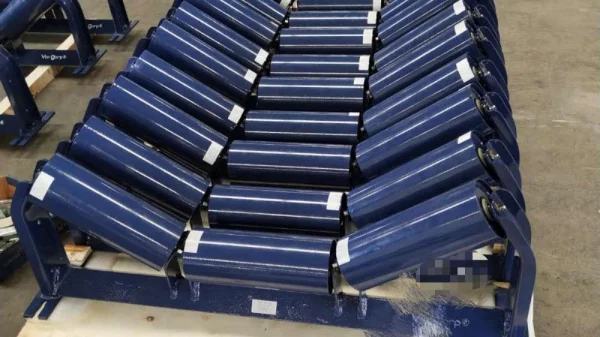
4. Key Engineering Factors Beyond the Roller Shell Material
Choosing the correct shell material is only part of the job. A high-quality roller can still fail prematurely if its dimensions, internal components, or operating conditions are not properly matched.
4.1 Load Capacity and Shell Stiffness
The roller must support the combined load from the conveyor belt and conveyed material.
This load depends on several factors:
- Belt width and belt mass.
- Material bulk density.
- Conveyor capacity.
- Idler spacing.
- Troughing configuration.
- Material distribution across the belt.
- Impact and dynamic loading.
A higher conveyor capacity does not automatically mean that every roller needs a thicker shell. Load distribution, roller length, support geometry, and installation arrangement also matter.
For polymer rollers in particular, designers should examine shell deflection under sustained load rather than relying only on short-term strength values.
4.2 Abrasion Resistance and Wear Mechanisms
Not all abrasive wear is the same.
Fine particles can produce continuous surface abrasion, while large and sharp lumps can cause gouging and impact damage.
A useful distinction is:
- Sliding abrasion: Material moves against the roller surface and gradually removes material.
- Impact wear: Falling or moving lumps strike the roller surface.
- Contaminated contact wear: Fine particles become trapped between the belt and roller, increasing surface deterioration.
- Carryback-related wear: Residual material accumulates on return rollers and creates uneven contact.
The correct material depends on which wear mechanism dominates.
For instance, a highly abrasion-resistant surface may still fail early if it is exposed to severe impact loading for which it was not designed.
4.3 Operating Temperature
Temperature affects both metal and polymer roller performance.
For polymer and rubber materials, excessive heat may change hardness, stiffness, dimensional stability, and fatigue behaviour. For metal rollers, the bearing lubricant and sealing materials may become the limiting factors before the shell itself does.
Always evaluate both the continuous operating temperature and the maximum temperature reached during temporary process variations.
4.4 Corrosion Resistance
Corrosion can affect more than the outside of the roller. The shaft, bearing housing, end caps, fasteners, and sealing interfaces are all potential weak points.
In a marine environment, chemical handling facility, or wet processing plant, the complete roller assembly should be evaluated rather than specifying a corrosion-resistant shell in isolation.
4.5 Bearing Sealing and Contamination Protection
In many bulk handling installations, roller failure begins inside the bearing assembly. Fine dust, water, mud, and chemical contamination can enter through inadequate seals.
A good sealing arrangement may include combinations of labyrinth seals, contact seals, flingers, and protective shields.
The correct arrangement depends on the contamination level, rotational speed, temperature, and maintenance conditions.
For dusty applications such as cement, limestone, and fly ash handling, effective bearing sealing should be treated as a primary design requirement.
4.6 Roller Diameter and Rotational Speed
Roller diameter affects rotational speed, bearing behaviour, belt contact, and shell loading.
The rotational speed can be estimated using:
n = 60 × v / (π × D)
Where:
- n = roller rotational speed (rpm).
- v = conveyor belt speed (m/s).
- D = roller outside diameter (m).
For example, at a belt speed of 3 m/s, a roller with a 159 mm outside diameter rotates at approximately 361 rpm.
This relationship is useful when evaluating bearing selection and roller operating conditions.
However, diameter should not be selected from belt speed alone. Roller load, tube wall thickness, belt width, available installation space, and required bearing life must also be taken into account.
5. Comparison of Common Conveyor Roller Materials
The following table provides a general starting point for evaluating different materials.
| Roller material | Main advantages | Main limitations | Typical applications |
| Carbon steel | High strength, rigidity, economical | Requires corrosion protection | Mining, quarrying, coal, cement |
| Galvanized or coated steel | Mechanical strength with improved surface protection | Coating can be damaged by abrasion | Ports, outdoor conveyors, aggregate |
| Stainless steel | Corrosion resistance in compatible environments | Higher cost, grade-specific limitations | Chemical plants, salt, wet processing |
| HDPE | Lightweight, low noise, corrosion resistance | Creep, stiffness and temperature limitations | Ports, fertilizer, selected mining conveyors |
| Nylon (PA6) | Strength, stiffness and wear resistance | Moisture sensitivity, formulation-dependent performance | Specialized industrial conveying |
| Rubber-covered steel | Impact absorption and cushioning | Compound aging and temperature limitations | Loading zones, transfer points |
| Polyurethane-coated steel | Abrasion resistance and anti-buildup properties | Compound and bonding requirements | Wet, sticky and corrosive applications |
| Ceramic-enhanced surface | High resistance to selected abrasive wear mechanisms | Impact sensitivity and higher cost | Specialized severe-wear locations |
The table should be treated as a preliminary selection guide rather than a substitute for engineering verification.
6. How to Choose the Right Belt Conveyor Roller Material
For equipment manufacturers, conveyor contractors, and bulk terminal operators, the selection process should start with the operating conditions rather than a preferred material.
A practical approach is to work through the following steps.
Step 1: Identify the conveyed material
Determine the material type, bulk density, particle size, moisture content, abrasiveness, and chemical characteristics.
Coal, wet limestone, iron ore, fertilizer, and fly ash have very different effects on roller performance.
Step 2: Define the mechanical loading
Check belt width, belt speed, conveyor capacity, idler spacing, trough angle, roller diameter, material lump size, and transfer point impact.
This information helps establish the shell strength, wall thickness, shaft dimensions, and bearing requirements.
Step 3: Evaluate the operating environment
Consider humidity, salt exposure, rain, chemical fumes, dust, temperature fluctuations, and cleaning procedures.
This stage often determines whether ordinary steel, coated steel, stainless steel, or polymer construction should be considered.
Step 4: Identify the dominant failure mechanism
Ask what is most likely to cause premature failure:
- Shell wear?
- Corrosion?
- Bearing contamination?
- Impact damage?
- Material buildup?
- Thermal deformation?
- Excessive rotational resistance?
The answer often makes the material decision much clearer.
Step 5: Check the complete roller construction
Do not evaluate the shell in isolation.
Review bearing type, sealing arrangement, shaft material, end-cap construction, shell thickness, concentricity, and surface finish.
Step 6: Compare the total operating cost
The lowest initial purchase price does not necessarily produce the lowest operating cost.
A roller that requires frequent replacement can create additional labour costs, production interruptions, maintenance access expenses, and potential belt damage.
For remote mining conveyors or high-throughput port terminals, a longer service life can be worth considerably more than a small difference in unit price.
7. Why the Lowest-Priced Conveyor Roller Is Not Always the Most Economical
When purchasing conveyor rollers in large quantities, it is tempting to compare suppliers primarily by price.
However, even a relatively small difference in roller performance can have a substantial effect across a large conveyor installation.
Consider a long-distance conveyor with hundreds or thousands of rollers. If the rollers experience premature bearing failure because of poor sealing, maintenance teams may need to replace them repeatedly. If the shell surface wears unevenly, belt tracking problems may develop. If a roller seizes, the stationary shell can generate friction against the moving belt and create a much more serious problem than the original roller failure.
These problems can lead to:
- Additional maintenance labour.
- Unplanned conveyor shutdowns.
- Increased belt wear.
- Higher spare-parts consumption.
- Material spillage and cleaning work.
- Additional operating costs.
A better purchasing decision evaluates the complete roller assembly and its expected performance under actual working conditions.
For critical conveyors, manufacturers and end users should request material specifications, load ratings, dimensional tolerances, bearing information, sealing details, and relevant performance test data.
The objective is not simply to purchase the strongest roller. It is to purchase a roller whose design and materials match the intended application.
Conclusion
Belt conveyor roller material selection is a decision that directly affects conveyor reliability, maintenance requirements, and long-term operating costs.
Carbon steel remains a dependable option for many heavy-duty bulk conveying applications because of its strength, stiffness, and economical manufacturing characteristics.
Stainless steel and protective coatings provide additional corrosion protection where required. HDPE and engineered polymer rollers offer advantages in weight reduction, corrosion resistance, and noise control. Rubber and polyurethane address specialized requirements involving impact absorption, abrasion, and material buildup. Ceramic-enhanced surfaces can be considered for selected severe-wear applications.
The right solution depends on the relationship between the conveyed material, mechanical loading, operating environment, and maintenance requirements. For ports, mines, power stations, quarries, and chemical facilities, a well-designed conveyor system may use several different roller constructions rather than relying on one material throughout the entire conveyor line.
Ultimately, successful material selection comes down to understanding how the roller will actually work after installation, not simply comparing material names on a quotation.
A roller designed around the real operating conditions is more likely to deliver stable rotation, reliable belt support, reduced maintenance, and a longer service life.
- Rubber Ring for Belt Conveyor Roller
- Common Conveyor Roller Imperial Dimensions
- Common Conveyor Roller Metric Dimensions
- Aggregate Conveyor Rollers for Conveyor System
- The Main Causes of Conveyor Rollers Wear
- Belt Conveyor Roller With Rubber Rings

Next: Index Page
Table of Contents

Leading Mobile Bulk Material Handling Equipment Manufacturer in China. A high-tech enterprise specializing in R&D and manufacturing of stacker conveyors, ship loaders, and bucket wheel reclaimers. We provide comprehensive mobile solutions, including mobile hopper feeders, truck unloaders (surface feeders), and transfer conveyors, alongside high-performance mobile crushing and screening plants for global bulk material processing.
How to Contact
- WhatsApp: +8617821512097
- E-mail: [email protected]
-
 Add: China

