
 REQUEST A QUOTE
 EN
 English
Just let we know what you want, and we will get in touch with you as soon as possible!

Conveyor Idlers and Rollers for Mobile Belt Conveyors
Mobile belt conveyors are designed to move bulk materials where fixed conveying infrastructure is impractical, expensive, or simply too restrictive. They are widely used in quarries, mining operations, stockyards, ports, crushing plants, grain terminals, and temporary material handling sites.
Unlike a conventional fixed conveyor, a mobile belt conveyor may be repositioned several times during its service life. It may operate on crawler tracks, pneumatic tires, rail-mounted travel systems, or a portable supporting frame. Some units also feature radial slewing, boom luffing, folding, or telescopic extension.
These operating characteristics place different demands on conveyor idlers and rollers.
A roller that performs well on a permanently installed conveyor may not automatically be the best choice for a tracked stacker or mobile transfer conveyor. The supporting structure can experience vibration during relocation, operating geometry may change, and maintenance access is often limited by the machine's compact layout.
For equipment manufacturers and operators, selecting the right conveyor idlers is therefore about more than matching belt width and roller diameter. The idler assembly must work reliably with the mobile conveyor's structure, movement, operating position, belt loading, and maintenance requirements.
This article examines how to select conveyor idlers and rollers specifically for mobile belt conveyors, including tracked conveyors, mobile stackers, radial stackers, telescopic conveyors, grasshopper conveyors, and mobile ship loaders.
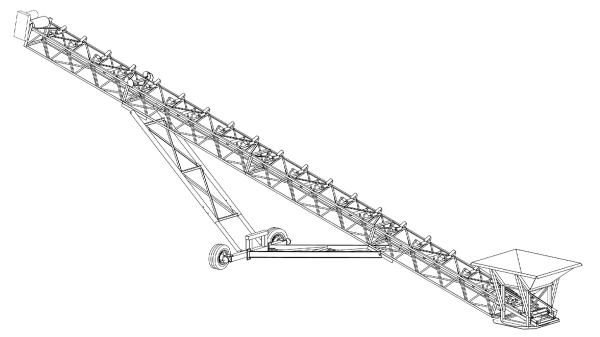
This is a radial stacker for small capacity stockpiling.
1. Why Mobile Belt Conveyors Need Different Idler Considerations
A fixed belt conveyor normally operates with a relatively stable supporting structure. Once the conveyor is installed, its foundation, idler frames, belt path, and working geometry remain largely unchanged.
Mobile conveyors have a different operating environment.
A tracked conveyor may move across a quarry floor or stockyard. A wheeled transfer conveyor may be repositioned between different loading points. A radial stacker changes its working position as it builds a stockpile, while a telescopic stacker extends and retracts its boom to increase its discharge reach.
The mechanical demands on the idler system can therefore vary between operating conditions.
1.1 Vibration During Relocation
Mobile conveyors are frequently moved between working areas. During travel, vibration and mechanical shock can be transmitted through the chassis, support structure, conveyor frame, and idler mounting points.
The actual loads depend on travel speed, ground conditions, suspension or track design, machine configuration, and transport arrangement.
This means idler selection should consider more than the normal static load from the belt and material. The supporting frames, mounting brackets, fasteners, and roller assemblies must also be suitable for the equipment's relocation conditions.
An important distinction is that the conveyor belt is normally operated under its specified working configuration. Travel and transport conditions should follow the machine manufacturer's procedures. conveyor rollers are not designed to act as transport supports for the complete machine.
1.2 Changing Working Positions
Mobile belt conveyors often operate at different boom angles, discharge heights, and working positions.
When a radial stacker slews, the equipment rotates around its pivot point. A luffing conveyor changes its boom elevation, while a telescopic conveyor changes its extension position.
These movements affect the geometry and loading of the supporting structure. The idler frames must remain correctly positioned relative to the belt throughout the intended operating range.
If structural deflection or mounting distortion changes the alignment of the idler frames, belt tracking problems may develop.
1.3 Compact Structure and Weight Limitations
Mobile equipment is normally designed around transport dimensions, machine stability, mobility, and lifting or supporting arrangements.
Unlike a large fixed conveyor, a mobile conveyor may have limited space for heavy structural components and oversized idler assemblies.
The weight of the idler system can therefore become part of the overall machine design calculation.
However, reducing weight should not compromise roller stiffness, bearing capacity, frame rigidity, or service life. The objective is to achieve a practical balance between structural strength, component weight, and operating reliability.
1.4 Maintenance Access
Many mobile conveyors have long, narrow booms or compact under-belt structures. Some roller positions may be difficult to access without repositioning the machine or using suitable maintenance platforms.
A seized roller can become more than a simple replacement issue. It may cause belt damage, increase friction, generate heat, or interrupt the material handling process.
For mobile equipment, an easy-to-replace idler design can be just as important as the initial roller specification.
2. Main Types of Conveyor Idlers and Rollers for Mobile Belt Conveyors
The correct idler configuration depends on the conveyor design, loading arrangement, belt profile, and operating conditions. A mobile belt conveyor typically uses several types of idlers along its belt path.
2.1 Carrying Troughing Idlers
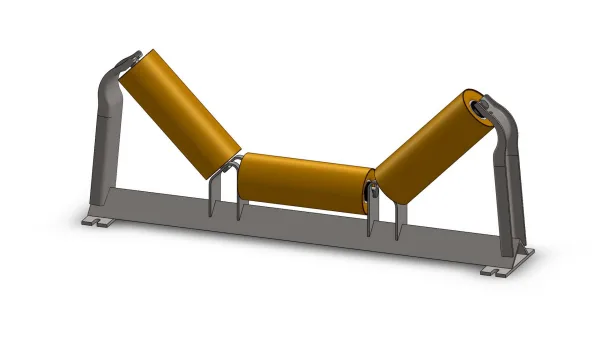
Carrying troughing idlers are installed beneath the loaded side of the conveyor belt. Their function is to support the belt and form a trough-shaped carrying profile.
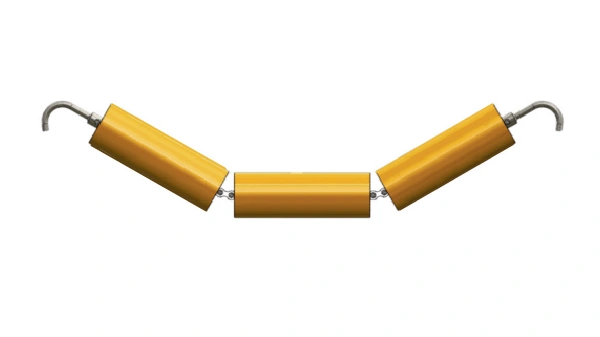
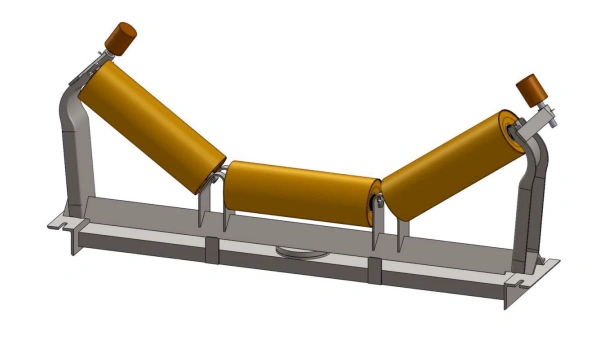
A conventional three-roll troughing idler assembly consists of:
- One horizontal centre roller
- Two inclined wing rollers
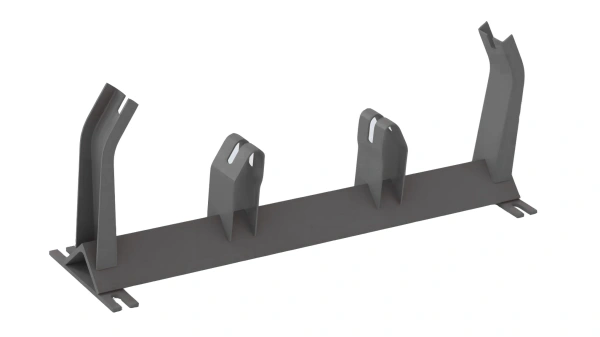
- An idler support frame
- Bearings, seals, and mounting brackets
The inclined rollers create a trough that helps contain bulk material and makes better use of the available belt width.
Common troughing angles include 20°, 30°, 35°, and 45°. The appropriate angle should be selected according to the belt width, material characteristics, capacity, belt flexibility, and conveyor design.
For mobile belt conveyors, the selection also needs to consider the supporting frame and the machine's operating geometry.
A 35° troughing idler may be suitable for many conventional bulk material applications, but it should not automatically be specified for every mobile conveyor. Belt flexibility, pulley diameter, loading conditions, and the transition arrangement must all be checked.
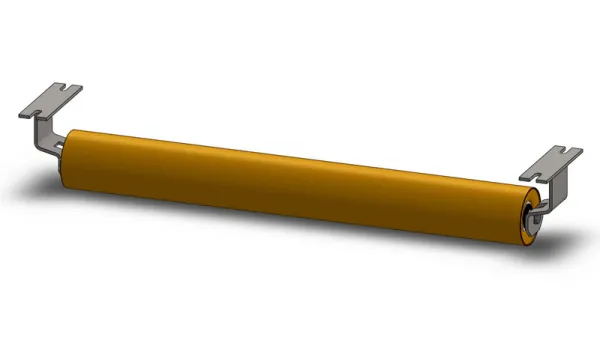
2.2 Flat Return Idlers
Return idlers support the empty belt as it travels from the discharge pulley back toward the loading end.
Flat return rollers are commonly used on mobile conveyors because of their relatively simple structure and straightforward installation.
Their mounting arrangements should provide adequate belt clearance and allow convenient inspection or replacement.
Even though return idlers do not normally carry bulk material, they remain important for belt tracking and preventing unnecessary wear on the belt's bottom cover.
2.3 V-Return Idlers
V-return idlers support the return belt in a shallow V-shaped profile rather than a completely flat arrangement.
They can help improve return-belt stability in suitable conveyor configurations.
For mobile conveyors, the use of V-return idlers should be assessed against the available frame space, belt construction, pulley arrangement, and return-path geometry.
They are not automatically necessary on every short mobile conveyor.
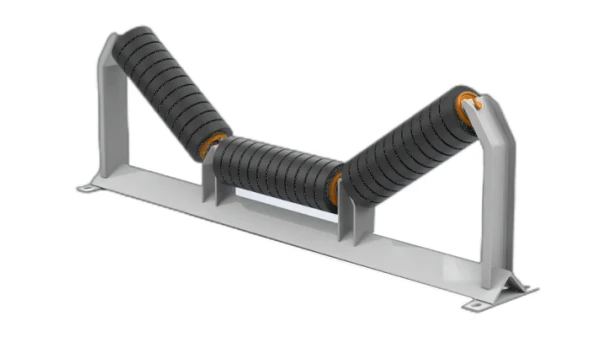
2.4 Impact Idlers
Mobile hopper feeders, truck unloaders, and mobile conveyor receiving sections can experience concentrated material loading.
At these locations, impact idlers provide cushioned support beneath the belt. They generally use rollers fitted with rubber rings or other impact-resistant materials to absorb part of the impact energy.
Their performance depends on the material's lump size, bulk density, drop height, feeding rate, and belt speed.
For particularly severe loading conditions, an impact bed may be a better option because it provides more continuous belt support across the loading zone.
Impact idlers and impact beds should therefore be selected according to the actual transfer-point arrangement rather than simply replacing one with the other.
2.5 Transition Idlers
Transition idlers are used where the belt changes between a flat or partially troughed profile and its normal carrying trough.
They are commonly positioned near the head and tail pulley areas.
Their purpose is to provide a gradual change in belt shape and avoid excessive stress on the belt edges.
This is important on mobile conveyors with relatively compact pulley arrangements, where available transition distance may be limited.
The transition profile must be compatible with the belt manufacturer's recommendations and the conveyor's operating tension.
2.6 Self-Aligning Idlers
Self-aligning idlers are designed to help correct belt mistracking by applying a steering action to the belt.
They may be used on the carrying or return side, depending on the design.
For mobile conveyors, however, self-aligning idlers should not be treated as a permanent solution to poor installation or structural misalignment.
Before installing them, check the machine's supporting structure, conveyor levelling, pulley alignment, loading conditions, and existing idler positions.
The belt should ideally run centrally because the conveyor structure and belt path are correctly designed and installed, not because tracking devices are constantly correcting underlying problems.
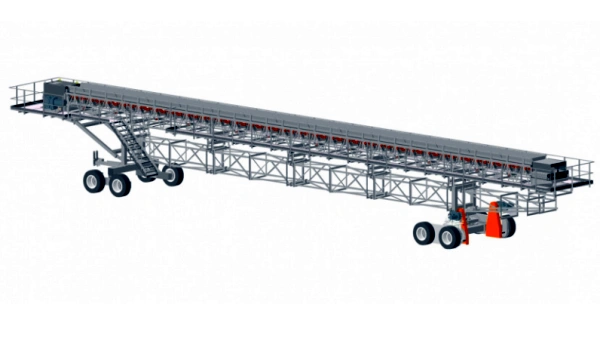
This is a mobile horizontal belt conveyor for bulk material tranferring.
3. Conveyor Idlers for Different Types of Mobile Belt Conveyors
Mobile belt conveyors do not all operate in the same way. A tracked stacker, a radial conveyor, and a telescopic ship loader have different mechanical arrangements and operating requirements.
3.1 Tracked Mobile Conveyors
Tracked conveyors are commonly used in quarries, crushing plants, mining operations, and stockyards.
Crawler tracks allow the conveyor to travel across working areas without requiring permanent foundations or fixed transfer locations.
Typical applications include:
- Mobile crushing plant discharge conveyors
- Tracked transfer conveyors
- Mobile stockpiling conveyors
- Tracked radial stackers
- Mobile hopper feeder stackers
The idler frames on tracked conveyors should be designed for the structural conditions associated with mobile equipment.
Important considerations include:
- Frame rigidity: The idler support must maintain its intended geometry under operating loads and the structural movement associated with repositioning.
- Bearing protection: Tracked equipment often works in dusty and outdoor environments. Effective sealing helps protect bearings from dust, dirt, and moisture.
- Mounting security: Roller shafts, brackets, and fasteners should remain secure under the specified operating and transport conditions.
- Replacement access: The idler arrangement should allow maintenance personnel to replace rollers without unnecessary dismantling of adjacent components.
For tracked equipment, the engineering priority is not simply to select a heavier roller. The complete assembly needs to provide suitable load capacity, alignment stability, sealing, and practical maintenance access.
3.2 Wheeled Mobile Belt Conveyors
Wheeled mobile conveyors are used in material stockpiling, truck loading, quarry operations, and general bulk transfer applications.
They can be moved around the site using their own travel system or an appropriate towing arrangement, depending on the equipment design.
The idler assembly should be compatible with the conveyor frame and its transport configuration.
Particular attention should be paid to:
- Roller and frame mounting security
- Belt clearance along the entire conveyor length
- Vibration during site relocation
- Protection against dust and moisture
- Easy access to return rollers
- Structural alignment after repositioning
A mobile conveyor that is repeatedly moved between different work areas should be inspected after relocation, especially if it has travelled over uneven ground.
3.3 Mobile Radial Stackers
Radial stackers use a pivoting arrangement to move the conveyor boom through an arc, allowing bulk material to be deposited over a larger stockpile area.
The belt and idler system must maintain reliable operation throughout the intended slewing range.
Several points deserve attention:
- Belt tracking: The belt should remain centred as the radial stacker changes its position. Incorrect alignment, uneven support, or off-centre loading can cause tracking problems.
- Boom structure: The supporting structure must maintain adequate stiffness under the load imposed by the belt, material, and operating mechanisms.
- Roller arrangement: Carrying and return idlers should be positioned to provide consistent belt support along the boom.
- Maintenance access: Idlers located along elevated or extended booms should be designed with practical replacement and inspection arrangements.
One issue seen in field operation is belt mistracking that appears only at certain boom positions. This can indicate a change in supporting geometry, frame deflection, or alignment rather than a defective individual roller.
For this reason, tracking should be checked with the machine correctly positioned and stabilized in its intended operating configuration.
3.4 Radial Telescopic Stackers
A radial telescopic stacker combines radial movement with boom extension.
This allows the machine to change both its working radius and discharge reach, improving stockpile coverage and reducing the need for frequent material rehandling.
The idler system must be compatible with the mechanical arrangement of the telescopic boom.
Depending on the machine design, this may involve separate conveyor sections, supporting structures, and belt arrangements that change position during extension and retraction.
Key considerations include:
- Correct roller dimensions for each conveyor section
- Adequate belt support throughout the operating range
- Clearance between the belt, idlers, and structural members
- Consistent alignment between moving sections
- Access to rollers and bearings for inspection
- Protection of mounting components during retraction and transport
A telescopic boom should not be treated as a standard fixed conveyor simply made longer. Its mechanical interfaces and movement sequence need to be considered when designing the belt-support system.
3.5 Mobile Transfer and Grasshopper Conveyors
Grasshopper conveyors are commonly used as mobile transfer units in mining, quarrying, and bulk material handling systems.
Several units may be connected to create a temporary conveying route between a crusher, stockpile, processing plant, or loading point.
Their idler requirements are influenced by repeated repositioning, modular construction, and compatibility with the surrounding conveyor system.
Important design considerations include:
- Standardized idler dimensions across compatible conveyor units
- Strong but practical idler mounting arrangements
- Reliable roller sealing
- Suitable carrying and return idler configurations
- Convenient replacement of individual rollers
- Consistent belt alignment at transfer interfaces
Where multiple grasshopper conveyors are connected in series, the transfer points must also be aligned properly. An unsuitable receiving or discharge arrangement can create off-centre loading, material spillage, and unnecessary wear on the idler system.
3.6 Mobile Ship Loaders
Mobile ship loaders are used in ports and terminals to transfer dry bulk materials from shore-side conveying equipment into vessel holds.
Depending on the equipment design, the conveyor boom may feature radial movement, telescopic extension, luffing, or mobile travel.
In addition to the mechanical requirements of mobile equipment, ship loader idlers may be exposed to:
- High humidity
- Salt-laden air
- Wind-driven rain
- Abrasive dust
- Continuous outdoor operation
Bearing sealing and corrosion protection are particularly important.
A well-coated roller shell is not enough on its own. The bearing housing, shaft ends, fasteners, and internal sealing arrangement must also be suitable for the marine environment.
Maintenance access is another concern because some rollers may be located high above the berth or over the water.
For this reason, the serviceability and reliability of the idler assembly should be considered during the ship loader design stage.
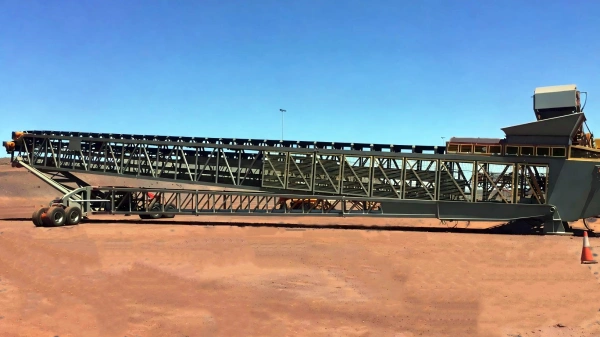
This is a radial telescopic stacker for large capacity bulk material handling.
4. How to Select the Right Idler Frame for a Mobile Conveyor
The idler frame supports the rollers and determines their relative position beneath the belt.
For mobile conveyors, frame design is especially important because the structure must accommodate both operating loads and the movement characteristics of the machine.
The following factors should be evaluated.
4.1 Frame Strength and Stiffness
The idler frame must remain sufficiently rigid under the expected loads.
Excessive frame deformation can change the roller positions, affect belt support, and contribute to mistracking.
Frame design should account for the conveyor's belt width, idler spacing, material load, supporting structure, and relevant mobile operating conditions.
4.2 Mounting Arrangement
Mobile conveyor frames often have limited installation space.
The idler assembly may need to fit within a compact truss, channel frame, or fabricated boom structure.
Before selecting an idler, confirm:
- Mounting hole spacing
- Frame width and height
- Shaft-end dimensions
- Roller removal clearance
- Available access for fasteners
- Compatibility with the conveyor structure
A roller may have the correct diameter and length but still be unsuitable if its mounting interface does not match the idler frame.
4.3 Weight and Structural Compatibility
A heavier idler frame may provide greater stiffness, but the additional weight also affects the overall mobile machine.
On a tracked stacker or telescopic conveyor, the structural design may have to account for boom weight, lifting mechanisms, transport dimensions, and machine stability.
Lightweight materials or reduced-section frames may be considered where appropriate, but the final arrangement must maintain sufficient mechanical strength.
4.4 Modular Construction
For equipment that is frequently moved or serviced, modular idler assemblies can simplify maintenance.
A standardized design can also help equipment manufacturers reduce the number of different spare roller specifications required across a product range.
However, standardization should not be achieved by using one assembly regardless of operating conditions. Carrying, impact, transition, and return positions still require functionally suitable configurations.
5. Selecting conveyor roller Diameter and Material for Mobile Equipment
Roller diameter and material selection influence the mechanical performance, weight, and service life of mobile conveyor idlers.
5.1 Roller Diameter
Roller diameter affects rotational speed, bearing selection, shell strength, and contact conditions between the belt and roller.
For the same belt speed, a larger-diameter roller rotates more slowly than a smaller-diameter roller.
The selected diameter should be compatible with:
- Belt width and speed
- Material loading
- Idler spacing
- Bearing capacity
- Available structural clearance
- Expected duty cycle
On mobile conveyors, compact structural design may limit the available roller diameter. However, selecting the smallest possible roller simply to save space can create unnecessary compromises in bearing life and mechanical performance.
The engineering objective is to select a diameter that satisfies the loading requirements while fitting the mobile conveyor's structural arrangement.
5.2 Steel Rollers
Steel conveyor rollers are widely used in bulk material handling equipment because of their established mechanical strength and suitability for demanding operating conditions.
They are commonly specified for tracked conveyors, mobile stackers, quarry conveyors, and heavy-duty transfer equipment.
Shell thickness, shaft design, welding quality, bearing fits, and surface finish should all be considered.
A well-designed steel roller should provide adequate stiffness without creating unnecessary weight.
5.3 HDPE and Polymer Rollers
HDPE and other polymer rollers can be considered where lower component weight, corrosion resistance, or specific operating characteristics are required.
They may be suitable for selected mobile conveyor applications, depending on the material load, operating temperature, belt speed, and environmental exposure.
However, polymer rollers should not automatically replace steel rollers on heavy-duty mobile equipment.
Their load capacity, deformation characteristics, temperature limits, and impact resistance must be verified against the actual operating requirements.
5.4 Rubber Disc Return Rollers
Rubber disc return rollers are useful in applications where sticky or damp material may adhere to the belt's return surface.
The rubber discs help reduce material accumulation on the return rollers.
For mobile conveyors handling wet aggregates, clay-containing materials, or other materials with carryback problems, this type of roller may be worth considering.
Correct selection still depends on the material characteristics and the belt-cleaning arrangement.
6. Bearing and Sealing Design for Mobile Conveyor Rollers
Bearings and seals are critical to roller reliability.
Mobile conveyors frequently operate in exposed working areas where dust, water, mud, and material fines can enter the surrounding environment.
If contaminants reach the bearing, friction and wear can increase rapidly.
6.1 Bearing Capacity
Bearing selection should be based on the actual roller load, belt speed, operating hours, roller diameter, and expected service conditions.
It is not sufficient to select a bearing purely because its dimensions fit inside the roller shell.
The bearing must provide suitable load capacity and rotational performance under the specified duty.
6.2 Sealing Performance
Seals protect the internal bearing components against external contamination.
Suitable sealing arrangements may include labyrinth seals, contact seals, or combined designs.
The selection depends on the working environment.
For example, a mobile conveyor operating in a dry aggregate yard may have different contamination requirements from a tracked conveyor working in wet and muddy conditions.
For mobile equipment, sealing should be considered together with bearing arrangement, roller speed, and maintenance strategy.
6.3 Grease and Lubrication
Many conveyor rollers use sealed bearing assemblies that are lubricated during manufacturing.
Where relubrication is required, the recommended grease type and maintenance interval should follow the roller manufacturer's instructions.
Excessive lubrication does not necessarily extend bearing life. Poor lubrication practices can also lead to higher operating temperatures and premature bearing problems.
6.4 Roller Runout and Rotational Balance
Roller manufacturing quality affects how smoothly the roller rotates.
Excessive runout or imbalance can generate vibration, especially at higher belt speeds.
For a mobile conveyor, vibration may be transmitted through a relatively compact structure. This makes dimensional consistency, shaft alignment, bearing fit, and shell manufacturing quality important considerations.
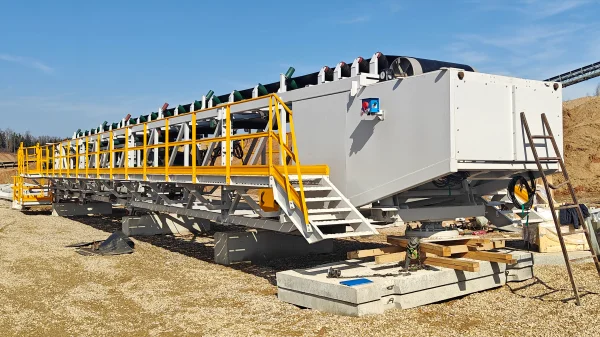
This is a radial stacker for aggregate handling.
7. Idler Spacing for Mobile Belt Conveyors
Idler spacing is the distance between adjacent idler assemblies.
It directly affects belt sag, roller loading, belt stability, and the number of idlers required along the conveyor.
For mobile conveyors, idler spacing must also be compatible with the supporting frame and the conveyor's operating geometry.
7.1 carrying idler Spacing
Carrying idler spacing should be determined according to:
- Belt width and weight
- Material bulk density
- Maximum material loading
- Belt tension
- Belt speed
- Idler load capacity
- Allowable belt sag
- Conveyor inclination
If the spacing is too large, the belt may sag excessively between idlers. This can affect the material profile and increase the risk of spillage.
If the spacing is unnecessarily small, the conveyor requires more rollers and mounting frames, increasing weight, cost, and maintenance requirements.
There is no single spacing value suitable for all mobile conveyors.
7.2 Loading Zone Idler Spacing
The material loading area often requires closer idler spacing than the normal carrying section.
Mobile hopper feeders and truck unloaders are particularly important examples.
Material entering the belt may produce a concentrated load or impact force. Closer support can help maintain the belt profile beneath the loading zone.
However, the spacing should be engineered in relation to the impact arrangement, belt stiffness, skirting system, and material characteristics.
7.3 Return Idler Spacing
Return idler spacing is normally determined by the belt's own weight, tension, sag limits, and the supporting frame arrangement.
Because mobile conveyors often have relatively short conveyor lengths, the available return-side clearance and mounting design may be important when deciding where to position the rollers.
The return side should also be checked for material build-up, roller fouling, and possible interference with supporting structures.
8. Belt Tracking: Why Mobile Conveyor Setup Matters
Belt tracking is one of the most common operational concerns on mobile belt conveyors.
A belt that runs centrally on a fixed conveyor may behave differently after the machine has been moved, repositioned, or set up on an uneven surface.
This is because the mobile conveyor's supporting geometry and alignment can change with the working position.
8.1 Level the Conveyor Before Adjusting Idlers
Before carrying out belt tracking adjustments, the mobile conveyor should be placed in its intended operating position.
Depending on the machine design, this may require:
- Positioning the chassis on a suitable surface
- Deploying stabilizing supports or outriggers
- Checking the conveyor's working inclination
- Confirming the boom is in the intended operating position
- Ensuring the conveyor structure is not twisted
- Checking the alignment of the head and tail pulleys
Making tracking adjustments before the machine is correctly positioned may lead to unnecessary changes later.
8.2 Check Idler Alignment
An idler that is installed at an incorrect angle can cause the belt to move sideways.
The rollers should be positioned squarely relative to the intended belt path, with adjacent frames aligned according to the conveyor design.
On mobile equipment, check the frames again after significant relocation or maintenance work.
8.3 Check Loading Position
Uneven loading is another common reason for belt mistracking.
When bulk material is deposited off-centre, the load distribution across the belt becomes uneven.
This can affect the belt's running position even when the idler frames are correctly installed.
The receiving hopper, feeder, and transfer chute should therefore be checked whenever a mobile conveyor has persistent tracking problems.
8.4 Do Not Use Training Idlers to Hide Structural Problems
Self-aligning idlers can help correct certain belt-tracking issues, but they cannot solve every underlying mechanical problem.
If the conveyor frame is twisted, the belt is incorrectly spliced, or the pulleys are misaligned, the root cause should be corrected first.
For mobile conveyors, proper machine positioning and structural alignment are particularly important because the equipment may operate in different locations and working configurations.
9. Common Idler and Roller Problems on Mobile Belt Conveyors
Mobile conveyors can experience several recurring idler-related problems.
| Problem | Possible cause | Recommended inspection |
|---|---|---|
| Roller seizure | Bearing contamination, lubrication failure, damaged seals | Check bearing condition, sealing, and roller rotation |
| Excessive roller noise | Bearing wear, loose components, contamination | Inspect bearings, shaft ends, and mounting hardware |
| Frequent belt mistracking | Incorrect setup, frame misalignment, uneven loading | Check machine levelling, pulley alignment, idler frames, and loading |
| Loose idler frame | Vibration, inadequate fastening, damaged mounting points | Inspect fasteners, brackets, and structural connections |
| Roller vibration | Excessive runout, imbalance, bearing damage | Check roller rotation and manufacturing condition |
| Belt cover wear | Seized roller, poor alignment, material build-up | Inspect rollers and belt-contact surfaces |
| Frame deformation | Overloading, structural damage, transport-related impact | Inspect frame stiffness, mounting points, and support structure |
| Corrosion | Outdoor exposure, moisture, unsuitable surface protection | Check shell, shaft ends, bearings, and protective coating |
One practical point is worth emphasizing: not every roller problem originates from the roller itself.
A damaged frame can cause repeated bearing or tracking problems even after new rollers have been installed. The complete assembly should be inspected whenever similar failures occur repeatedly.
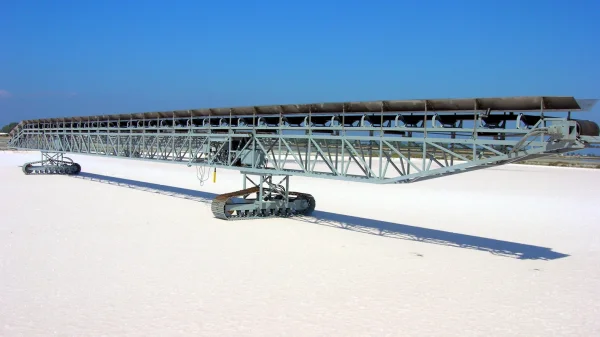
This is a tracked conveyor for salt conveying.
10. Maintenance of Conveyor Idlers and Rollers on Mobile Equipment
Maintenance planning for mobile conveyors should include both operational inspection and post-relocation checks.
A conveyor that has been moved from one work area to another may require additional inspection before returning to full operation.
10.1 Daily or Routine Inspection
Depending on operating hours and site conditions, routine checks should include:
- Listen for abnormal roller noise.
- Check for seized or slow-running rollers.
- Inspect carrying and return idlers for damage.
- Look for material build-up around rollers.
- Check for loose or missing fasteners.
- Observe belt tracking during operation.
- Inspect visible bearing and sealing areas.
Abnormal temperature, noise, or vibration should be investigated rather than ignored.
10.2 Inspection After Relocation
After significant movement, inspect the conveyor structure and idler mounting points.
Pay attention to:
- Damaged roller frames
- Loose mounting bolts
- Bent brackets
- Belt and pulley alignment
- Contact between the belt and structural members
- Changes in belt tracking
- Damaged or missing protective components
The inspection procedure should follow the mobile conveyor manufacturer's operating and transport instructions.
10.3 Planned Roller Replacement
It is generally more practical to replace rollers based on their condition rather than waiting for a complete failure.
For equipment operating in remote areas, keeping compatible replacement rollers and idler assemblies available can reduce maintenance delays.
Spare-parts records should include roller dimensions, bearing details, shaft-end configuration, seal design, idler frame type, and conveyor location.
All inspection, adjustment, and replacement work must be carried out with the conveyor safely isolated and according to the manufacturer's procedures.
11. How to Specify Conveyor Idlers and Rollers for a Mobile Belt Conveyor
A suitable technical specification helps prevent incorrect component selection and unnecessary modification during installation.
When requesting a quotation, provide the following information.
| Item | Required information |
|---|---|
| Conveyor type | Tracked conveyor, wheeled conveyor, radial stacker, telescopic stacker, grasshopper conveyor, or mobile ship loader |
| Belt width | Nominal belt width in mm |
| Belt speed | Operating belt speed in m/s |
| Capacity | Required throughput in t/h |
| Material | Coal, iron ore, aggregates, grain, fertilizer, or other bulk materials |
| Material properties | Bulk density, lump size, moisture, and abrasiveness |
| Idler position | Carrying, return, impact, transition, or self-aligning |
| Trough angle | 20°, 30°, 35°, 45°, or project-specific |
| Roller dimensions | Diameter, length, shaft diameter, and end configuration |
| Idler frame | Frame width, height, mounting hole spacing, and structure interface |
| Operating conditions | Inclination, boom extension, working position, duty cycle, and environment |
| Mobility conditions | Track or wheel arrangement, relocation frequency, and transport configuration |
| Bearing and seals | Bearing type, sealing arrangement, and lubrication requirements |
| Quantity | Number of rollers or complete idler assemblies required |
For replacement orders, drawings and photographs of the existing assembly are extremely helpful.
However, the original dimensions should still be checked against the actual conveyor design. An existing component may have been modified or may not match the intended technical specification.
12. Choosing a conveyor idler Manufacturer for Mobile Belt Conveyors
When purchasing idlers and rollers for mobile equipment, the lowest unit price does not always produce the lowest maintenance cost.
The supplier should understand the requirements of mobile conveying systems, not simply provide standard rollers based on belt width.
Several points deserve attention.
Product and engineering range
Can the manufacturer provide carrying idler sets, return idlers, impact idlers, transition idlers, and individual replacement rollers?
Can the products be configured for tracked, wheeled, radial, and telescopic conveyor structures?
Manufacturing quality
Check the consistency of roller dimensions, shaft machining, bearing fits, shell welding, rotational runout, and surface treatment.
These details influence roller performance and the ease of installation.
Bearing and sealing capability
The manufacturer should be able to recommend bearings and seals according to the operating environment, including dusty, wet, muddy, and outdoor conditions.
Frame compatibility
The manufacturer should understand the mounting dimensions and structural interface of the mobile conveyor rather than supplying rollers that merely fit the nominal belt width.
Maintenance support
A practical spare-parts programme should make it easier to replace worn or damaged rollers without redesigning the entire idler assembly.
For mobile belt conveyor manufacturers, consistent roller specifications across different equipment models can also simplify spare-parts management and after-sales service.
Conclusion: Reliable Idlers Support Reliable Mobile Conveying
Mobile belt conveyors are designed to work in changing locations and operating conditions. Their idler systems must therefore accommodate more than the normal weight of a moving belt and bulk material.
Structural vibration, repeated relocation, changing boom positions, compact frame design, uneven ground conditions, and limited maintenance access all influence the selection of conveyor idlers and rollers.
The most suitable solution is not necessarily the heaviest or most expensive roller. It is the assembly that provides the required load capacity, alignment stability, bearing protection, and practical service life within the mobile machine's structural and operating limits.
For tracked conveyors, mobile stackers, radial telescopic stackers, grasshopper conveyors, and mobile ship loaders, idler selection should be considered during the equipment design stage rather than left until the first replacement order.
Looking for conveyor idlers and rollers for mobile belt conveyor equipment? Prepare your belt width, speed, throughput, material properties, idler arrangement, mounting dimensions, and mobile equipment type. These details will help the manufacturer recommend a suitable roller and idler assembly for your application.
- Conveyor Idlers and Rollers for Overland Belt Conveyors: Selection, Performance and Maintenance
- Aggregate Conveyor Rollers for Conveyor System
- The Main Causes of Conveyor Rollers Wear
- Using Mobile Conveyors to Simplify Processes
- Components of Mobile Conveyors for Mining & Quarrying
- 18 Common Types of Belt Conveyor Idlers

Table of Contents

Leading Mobile Bulk Material Handling Equipment Manufacturer in China. A high-tech enterprise specializing in R&D and manufacturing of stacker conveyors, ship loaders, and bucket wheel reclaimers. We provide comprehensive mobile solutions, including mobile hopper feeders, truck unloaders (surface feeders), and transfer conveyors, alongside high-performance mobile crushing and screening plants for global bulk material processing.
How to Contact
- WhatsApp: +8617821512097
- E-mail: [email protected]
-
 Add: China

