
 REQUEST A QUOTE
 EN
 English
Just let we know what you want, and we will get in touch with you as soon as possible!

Conveyor Idlers and Rollers for Overland Belt Conveyors: Selection, Performance and Maintenance
An overland belt conveyor may run for several kilometres, cross uneven terrain, pass through horizontal and vertical curves, and operate continuously for thousands of hours each year. In a system like this, conveyor reliability is rarely determined by one component alone. It comes from how the belt, pulleys, idlers, drive system, structure, and transfer points work together.
Conveyor idlers and rollers are particularly important because they support the belt along almost the entire conveying route. A single roller may look like a relatively simple component, but a long overland conveyor can contain thousands of them. Small differences in rolling resistance, alignment, bearing quality, or sealing performance can therefore accumulate into considerable operating costs.
Selecting conveyor idlers and rollers for an overland belt conveyor is not simply a matter of matching the belt width. Engineers need to consider the belt load, operating speed, material characteristics, route profile, environmental conditions, and expected service life.
This article looks at the engineering factors that matter when selecting idler assemblies and individual rollers for long-distance bulk material conveying systems.
1. Why Conveyor Idlers Matter More on Overland Conveyors
In a short transfer conveyor, the replacement cost of an idler is often a relatively small part of the overall maintenance budget. On an overland conveyor, the situation is different.
The system may contain several kilometres of carrying and return idlers. Many are installed in remote locations, making inspection and replacement more difficult than on a plant conveyor. A failed roller can also create secondary problems if it remains unnoticed.
For example, a seized carrying roller increases friction between the belt and the stationary roller surface. Depending on the operating conditions, this can generate heat, damage the belt cover, increase power consumption, and eventually cause an unplanned shutdown.
There are several reasons why idler performance deserves particular attention in overland conveyor design.
- Energy consumption: Every idler contributes some resistance to belt movement. Bearing friction, seal drag, and deformation of the belt cover as it passes over the roller all contribute to the system's resistance.
- Belt tracking: Incorrectly aligned idler frames can introduce lateral forces that encourage the belt to move away from the centreline. Tracking problems become more complicated on long routes with multiple curves and changes in elevation.
- Component service life: Bearing contamination, material build-up, shell wear, and excessive loading can shorten roller life. Replacing components along a long conveyor route can involve significant labour and access costs.
- System availability: An idler failure may appear minor, but a damaged or seized roller can become a source of belt damage, overheating, or maintenance intervention.
For these reasons, idlers should be treated as performance-critical conveyor components rather than inexpensive consumables.
2. Conveyor Idlers vs. Conveyor Rollers: Understanding the Difference
The terms conveyor idler and conveyor roller are often used interchangeably in the industry. However, they do not always refer to the same product.
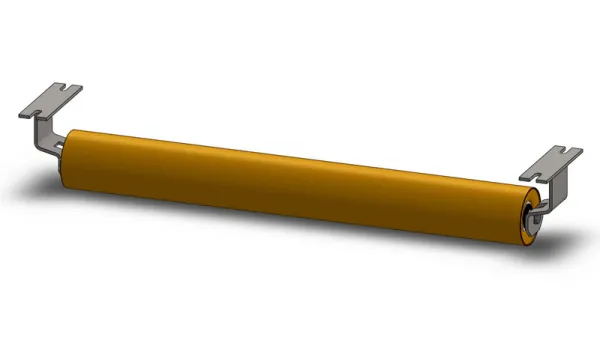
A conveyor roller is an individual rotating component. It typically consists of a steel or polymer shell, shaft, bearings, bearing housings, and sealing arrangement.
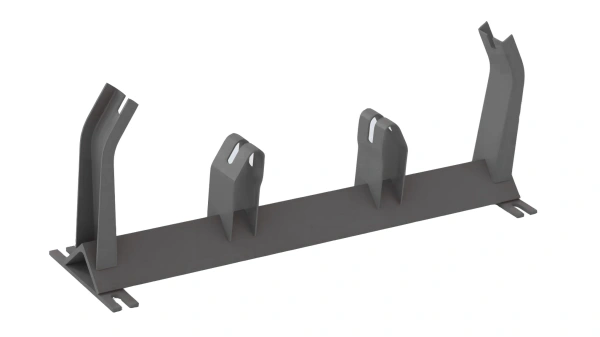
A conveyor idler assembly is the complete supporting unit installed beneath or alongside the belt. It usually consists of two or more rollers mounted in a frame or bracket.
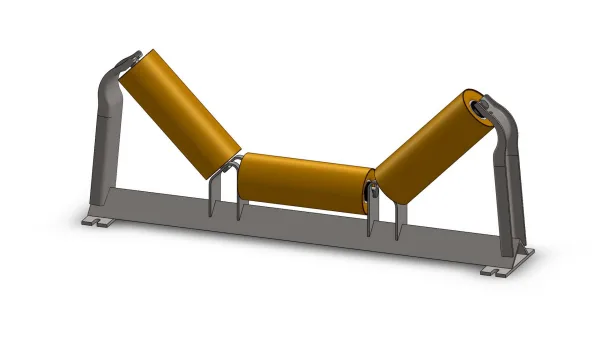
For example, a conventional three-roll troughing idler assembly contains one centre roller and two inclined wing rollers. The complete assembly supports the belt and helps maintain its trough-shaped profile.
This distinction is important during purchasing and maintenance.
When ordering conveyor rollers, the supplier needs the individual roller dimensions, shaft arrangement, bearing details, and other relevant specifications.
When ordering conveyor idler assemblies, the frame dimensions, roll configuration, trough angle, mounting arrangement, and roller specifications are also required.
For overland belt conveyors, both components must be considered together. A good-quality roller installed in a poorly designed or misaligned frame may still create operational problems.
3. Main Types of Conveyor Idlers Used on Overland Belt Conveyors
An overland conveyor does not use exactly the same idler arrangement along its entire length. Different sections have different support requirements.
3.1 Carrying Troughing Idlers
Carrying troughing idlers are installed beneath the loaded side of the conveyor belt. Their main purpose is to support the belt and bulk material while maintaining the required trough profile.
A typical three-roll assembly consists of a horizontal centre roller and two inclined wing rollers. The angle of the wing rollers determines the trough geometry.
Common troughing angles include 20°, 30°, 35°, and 45°, although the appropriate angle depends on belt design, capacity, material characteristics, and conveyor geometry.
For an overland conveyor carrying iron ore, coal, limestone, or aggregates, the troughing idler must support both the belt's own weight and the distributed material load.
The design should also consider belt sag between idler stations. Excessive sag can allow material to shift as it travels along the conveyor, increasing spillage risk and affecting belt stability.
3.2 Return Idlers
Return idlers support the empty belt on its return journey from the head pulley towards the tail pulley.
Flat return idlers are common, while V-return configurations can provide additional belt guidance under suitable operating conditions.
Although return idlers carry less load than carrying idlers in many applications, they should not be overlooked during selection.
A damaged or misaligned return roller can still generate drag, create belt-tracking problems, and cause wear on the belt's bottom cover.
Long overland conveyors require attention to the return side as well as the carrying side, particularly where the route passes through exposed or dusty environments.
3.3 Impact Idlers and impact idler Sets
Impact idlers are used where material falls onto the conveyor belt, particularly beneath loading chutes and at transfer points.
They generally use rollers fitted with rubber rings or other impact-resistant cushioning materials. Their purpose is to reduce localized impact forces and help protect the belt.
However, impact idlers are not necessarily the best solution for every loading point. Where the drop height is substantial or the material contains large, heavy lumps, a conveyor impact bed may provide more continuous support.
The selection should take account of:
- Maximum material lump size
- Bulk density and loading rate
- Material drop height
- Belt width and speed
- Chute configuration
- Expected impact severity
The impact zone should be engineered as part of the complete transfer system rather than selected independently.
3.4 Transition Idlers
Transition idlers are installed where the belt changes from a troughed profile to a flatter profile, usually near the head and tail pulleys.
A sudden change in trough geometry can create uneven belt tension across the belt width. If the transition is not designed properly, the belt edges may experience excessive stress.
Transition idlers provide a gradual change in belt profile. Their spacing and troughing angles should be coordinated with the belt manufacturer's recommendations and the conveyor's tension profile.
This detail becomes especially important on high-tension overland conveyors.
3.5 Self-Aligning Idlers
Self-aligning idlers are designed to help correct belt-tracking deviations. Depending on the configuration, they may be used on the carrying or return side.
They can be useful where persistent tracking problems have been identified, but they should not be considered a substitute for correct installation.
Before adding tracking idlers, engineers and maintenance teams should check the conveyor structure, pulley alignment, loading conditions, belt splice, and existing idler alignment.
A tracking device cannot reliably compensate for a fundamentally misaligned conveyor structure.
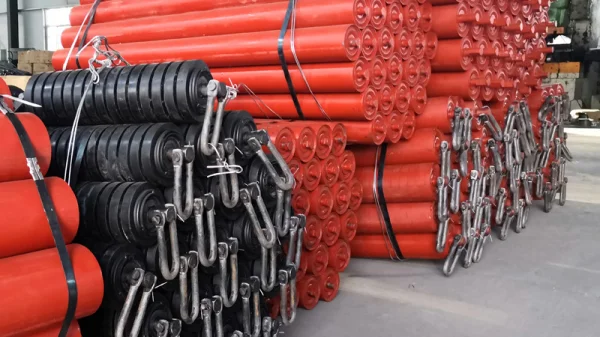
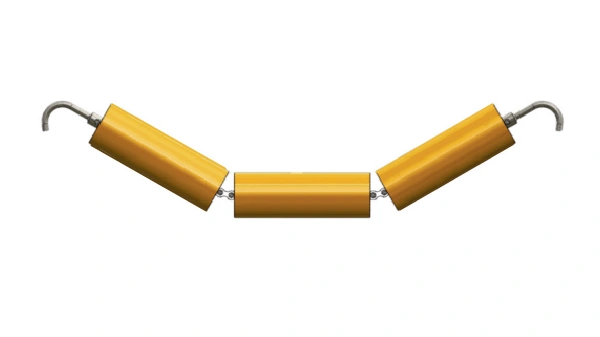
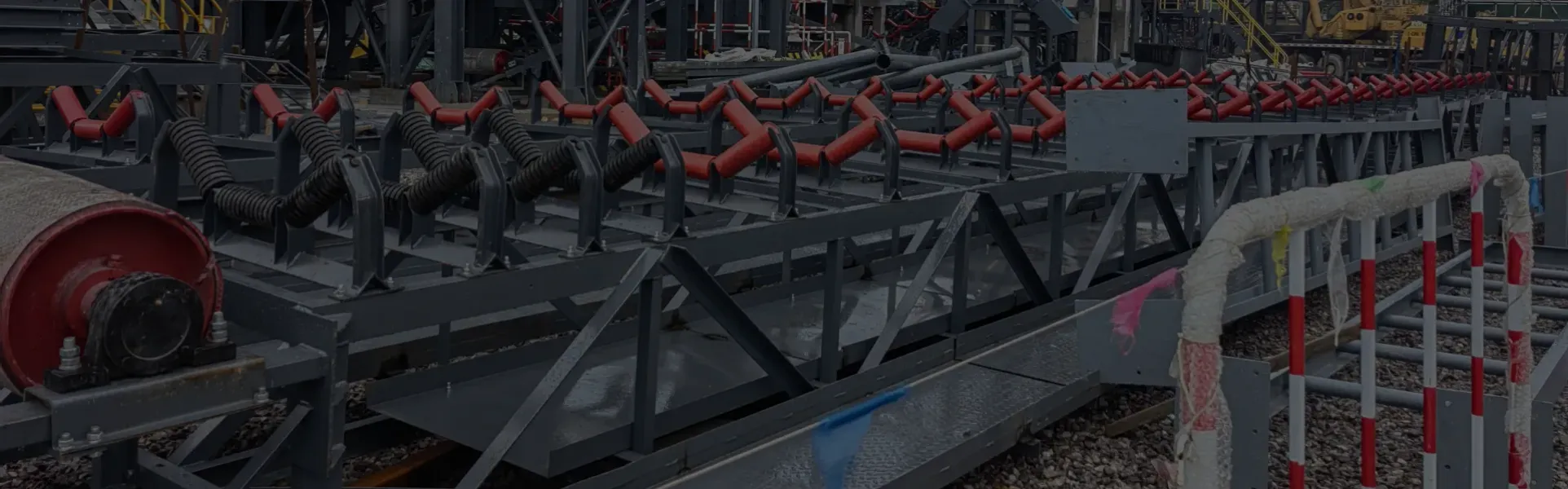
These are garland idlers for overland belt conveyor.
4. How to Select the Right conveyor rollers for Overland Applications
Roller selection has a direct influence on conveyor reliability, power requirements, and maintenance frequency. The following factors should be checked before choosing a roller specification.
4.1 Roller Diameter
Roller diameter affects rotational speed, bearing loading, shell strength, and the interaction between the belt and roller surface.
For a given belt speed, a larger-diameter roller rotates more slowly than a smaller one. It can also reduce local contact stresses and the indentation of the belt's bottom cover.
This is important because belt indentation rolling resistance can make a significant contribution to the resistance of long-distance belt conveyors.
Recent research has demonstrated the potential benefit of larger-diameter rollers. A 2025 study published in Lubricants investigated the influence of roller diameter on indentation rolling resistance and idler rotating resistance. Separately, research reported by the Minerals Research Institute of Western Australia in April 2026 found substantial reductions in indentation rolling resistance in its large-diameter roller testing programme.
These findings are promising, but they should not be interpreted as guaranteed whole-system energy savings. The actual result depends on belt properties, loading, temperature, roller design, bearing and seal arrangements, operating speed, and idler spacing.
Larger rollers may also require different frame clearances, mounting arrangements, and handling procedures. Their purchase cost and weight should be evaluated against the expected lifetime operating savings.
The best roller diameter is therefore the one that meets the mechanical requirements and provides a sound whole-life cost for the particular conveyor.
4.2 Roller Length and Shaft Dimensions
Roller length must match the idler frame and belt width.
For a troughing idler assembly, the centre and wing rollers may have different lengths and shaft arrangements. The shaft ends must also fit the corresponding frame slots or mounting points.
An incorrect roller length can create installation difficulties or interfere with the intended belt-support geometry.
For replacement rollers, measuring the original component is useful, but it is not always sufficient. The original roller may have been modified or incorrectly specified. It is better to confirm the dimensions against the idler assembly drawing.
4.3 Shell Material and Wall Thickness
Steel rollers are widely used in heavy-duty bulk material handling applications because they offer established mechanical strength and are suitable for a wide range of operating conditions.
However, shell thickness and construction quality need to be matched to the expected loading and service environment.
Important considerations include:
- Radial load and roller span
- Shell deformation under operating load
- Impact and abrasive wear
- Corrosion exposure
- Weld and end-disc quality
- Operating speed and runout requirements
A thicker shell is not automatically a better solution. Excessive weight can increase rotational inertia and handling requirements, while inadequate shell stiffness can lead to deformation and premature failure.
The design should balance strength, weight, manufacturing quality, and service life.
4.4 Steel, Polymer, and Composite Rollers
The choice of roller material depends on the conveyor environment and performance requirements.
Steel conveyor rollers are commonly specified for heavy-duty applications where load capacity, mechanical strength, and resistance to operating impacts are important.
HDPE and other polymer rollers can offer lower weight and corrosion resistance in suitable applications. Their mechanical properties, temperature limits, wear behaviour, and suitability for the expected loading must be checked.
Composite rollers may be considered where reducing component weight or improving particular performance characteristics is a priority. However, the construction must be validated for the actual operating load, impact conditions, and environmental exposure.
The correct material should be selected based on engineering requirements rather than price or weight alone.
5. Bearing and Sealing Systems: A Small Detail with a Big Impact
Bearings are among the most important parts of a conveyor roller.
A roller bearing must support the applied radial load while rotating continuously at the required speed. It must also operate in an environment that may contain fine dust, water, mud, abrasive particles, and temperature variations.
For overland conveyors, the bearing arrangement should be selected using the calculated roller load, operating speed, duty cycle, expected service life, and installation conditions.
5.1 Bearing Load and Service Life
Bearing selection should not be based solely on nominal bearing dimensions.
The design must consider the load acting on each roller, including the belt and material weight, operating tension effects, and any additional loads caused by structural misalignment.
Bearing life calculations provide an important design reference, but the calculated value does not guarantee the actual service life of the complete roller. Contamination, lubrication, installation quality, and operating temperature all influence real-world performance.
5.2 Seals and Contamination Protection
The sealing arrangement helps prevent dust, water, and other contaminants from reaching the bearing.
Common approaches include labyrinth-type seals, contact seals, and combined sealing arrangements. Each design has different characteristics in terms of sealing effectiveness, friction, and maintenance requirements.
A seal that performs well in a dry quarry may not be suitable for a conveyor exposed to frequent washdown or wet, abrasive material.
Engineers should therefore specify the sealing arrangement according to the actual environment, not simply choose the lowest-cost option.
5.3 Lubrication
Many conveyor rollers use factory-lubricated, sealed bearing arrangements designed for long-term operation without routine relubrication.
Where relubrication is required, the lubricant type, quantity, and maintenance interval must follow the manufacturer's instructions.
Both insufficient and excessive lubrication can create problems. Excess grease can increase internal friction and temperature, while inadequate lubrication can accelerate bearing wear.
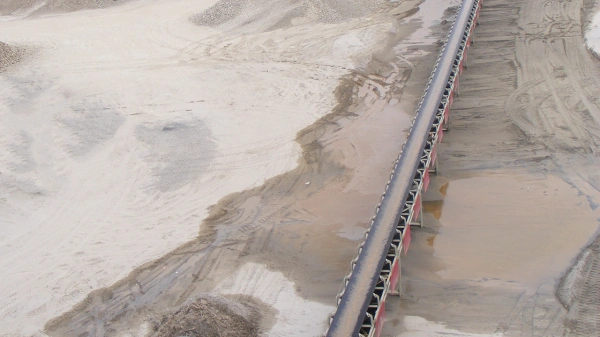
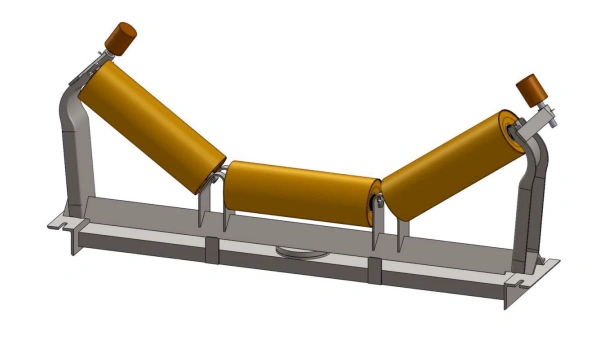
This is a trough idler belt conveyor.
6. Rolling Resistance and Energy Efficiency on Long-Distance Conveyors
One of the most important engineering considerations for overland conveyors is total resistance to belt movement.
It is useful to distinguish between two types of resistance associated with idler rollers.
Idler rotating resistance comes from the roller's internal components. Bearing friction, grease churning, and seal drag all contribute to the torque required to rotate the roller.
Indentation rolling resistance (IRR) occurs at the contact between the conveyor belt's bottom cover and the roller surface. As the belt passes over a roller, its rubber cover deforms under load. Because the rubber does not recover its deformation instantaneously, energy is dissipated.
These mechanisms are related but are not the same.
A roller with low bearing friction may still contribute to substantial indentation rolling resistance if the belt and operating conditions produce significant cover deformation.
Several factors influence total resistance:
- Roller diameter and surface condition
- Belt bottom-cover compound and thickness
- Belt speed and operating temperature
- Material load and belt tension
- Bearing and seal design
- Idler alignment
- Idler spacing and belt sag
This is why specifying low-resistance rollers alone does not necessarily produce an energy-efficient conveyor.
The belt, rollers, idler geometry, and operating profile must be considered as one system.
For a long overland conveyor, even a relatively small reduction in resistance per idler can become commercially meaningful when multiplied across thousands of rollers and many operating hours.
A proper engineering assessment should compare the initial investment against expected energy savings, maintenance requirements, replacement frequency, and the cost of downtime.
7. Idler Spacing and Alignment: Getting the Installation Right
Even well-manufactured conveyor idlers can perform poorly if they are installed incorrectly.
Two installation factors deserve particular attention: spacing and alignment.
7.1 Idler Spacing
Idler spacing determines how far the belt travels between support points.
If the spacing is too large, belt sag may become excessive. This can affect the material profile, increase material movement on the belt, and create conditions for spillage.
If the spacing is unnecessarily small, the conveyor requires more idler assemblies, increasing capital cost, component count, and maintenance workload.
Carrying idler spacing should be calculated according to belt tension, belt width, material loading, belt sag limits, and operating conditions.
Closer spacing is often required in loading zones, where the belt experiences greater impact and concentrated material loading.
Return idler spacing is generally different because the return belt carries no conveyed material. However, the belt's own weight, tension, and local route conditions must still be considered.
The correct arrangement is an engineering decision, not a fixed spacing rule that can be applied to every conveyor.
7.2 Idler Alignment
Idler alignment affects both belt tracking and rolling resistance.
If an idler is not square with the belt centreline, the belt may experience additional transverse sliding across the roller surface. This creates unnecessary drag and may accelerate wear.
Vertical misalignment can also place additional load on individual rollers, especially when one frame is installed higher than neighbouring frames.
During installation, check that:
- Idler frames are correctly positioned relative to the conveyor centreline.
- Rollers are square to the intended belt path.
- Adjacent frames are level and properly supported.
- Roller axes are parallel as specified in the design.
- The belt makes the intended contact with the carrying and return rollers.
- Mounting fasteners are correctly secured.
For long overland routes, survey-based alignment can be valuable, particularly where structural deflection, terrain changes, or horizontal curves make installation more challenging.
8. Common Conveyor Idler Problems and Their Causes
Understanding how rollers fail helps maintenance teams identify problems before they lead to major conveyor damage.
| Problem | Possible causes | Operational consequences |
| Seized roller | Bearing contamination, lubrication failure, corrosion | Belt wear, heat generation, increased drag |
| Excessive roller noise | Bearing damage, internal clearance, shell vibration | Early indication of mechanical deterioration |
| High bearing temperature | Poor sealing, excessive load, lubrication problems | Reduced bearing life and potential failure |
| Shell wear or corrosion | Abrasive material, wet conditions, unsuitable material | Reduced structural integrity |
| Excessive vibration | Roller runout, imbalance, bearing damage | Belt vibration and additional mechanical loading |
| Uneven roller wear | Misalignment, uneven loading, material build-up | Tracking problems and reduced service life |
| Frequent belt mistracking | Incorrect idler alignment, frame distortion, off-centre loading | Spillage, belt-edge damage, maintenance downtime |
One important point: belt mistracking is not always caused by the idlers.
A belt splice that is not square, a distorted conveyor structure, an incorrectly positioned pulley, or off-centre loading can all create tracking problems.
Replacing rollers without identifying the underlying cause may solve the immediate symptom but leave the original problem in place.
A systematic inspection should look at the complete conveyor section, including the structure, pulleys, idlers, belt, and loading arrangement.
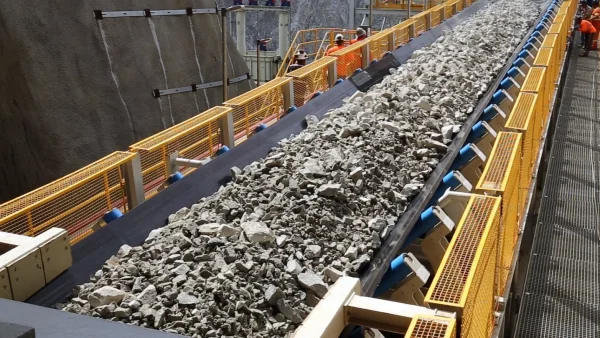
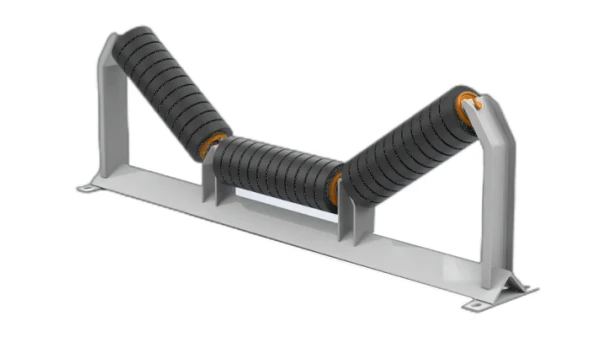
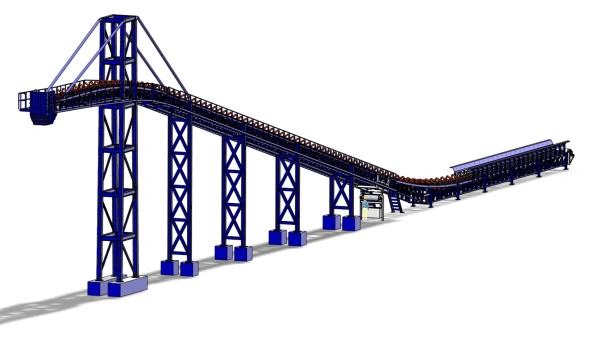
This is oveland belt conveyor using heavy conveyor idler rollers for supporting rubber belt.
9. Maintenance Strategy for Overland Conveyor Idlers and Rollers
A good maintenance programme focuses on identifying deterioration early rather than waiting for a roller to fail.
For long-distance conveyors, maintenance teams should establish inspection routes and record recurring defects by conveyor section.
Typical inspection activities include:
- Visual inspection: Check for damaged shells, corrosion, missing rollers, material build-up, loose mounting hardware, and signs of belt contact with the structure.
- Noise monitoring: Unusual noise may indicate bearing wear, seal damage, or mechanical looseness. Changes should be investigated rather than ignored.
- Temperature monitoring: Thermal inspections can help identify abnormal bearing temperatures. Temperature readings should be compared under similar operating conditions, because ambient temperature and loading affect the results.
- Vibration and condition monitoring: Where justified by conveyor criticality, vibration monitoring or other condition-monitoring methods can help identify deterioration before failure.
- Replacement management: Record roller type, dimensions, bearing arrangement, operating position, date of replacement, and suspected failure cause. This information helps determine whether a particular specification is under-performing.
Physical inspection or replacement work must follow appropriate isolation and lockout procedures. Personnel should never attempt to touch or adjust rotating rollers while the conveyor is running.
For remote overland conveyors, a planned replacement strategy is often more effective than relying entirely on emergency maintenance.
10. How to Specify Conveyor Idlers and Rollers for a New Overland Project
A detailed technical specification helps ensure that the selected components fit the conveyor design and can achieve the intended service life.
For a new overland conveyor, the supplier should receive as much of the following information as possible.
| Specification | Information required |
| Conveyor data | Belt width, belt speed, capacity, conveying distance |
| Material data | Material type, bulk density, lump size, abrasiveness, moisture |
| Idler arrangement | Carrying, return, impact, transition, or training |
| Idler geometry | Trough angle, roller configuration, frame dimensions |
| Roller dimensions | Diameter, length, shaft diameter, mounting details |
| Bearing details | Bearing type, load rating, sealing arrangement |
| Operating environment | Outdoor exposure, dust, water, corrosion, temperature |
| Design requirements | Applicable standards, design life, performance criteria |
| Project information | Installation drawings, component quantities, replacement requirements |
For replacement rollers, the original roller drawing or a complete dimensional measurement is particularly helpful.
The supplier should also know whether the new roller is intended to replace an existing component or form part of a newly designed idler assembly.
A technically correct selection at the purchasing stage can prevent a great deal of unnecessary adjustment and maintenance after installation.
11. Choosing an Idler and Roller Supplier for Overland Conveyors
For a long-distance conveyor project, the lowest unit price is not necessarily the lowest-cost option over the equipment's operating life.
A reliable supplier should be able to demonstrate that its rollers and idler assemblies are manufactured to consistent specifications and are suitable for the intended duty.
When evaluating a conveyor idler manufacturer, consider:
- Engineering capability: Can the supplier understand the conveyor arrangement, loading conditions, roller dimensions, and operating requirements?
- Manufacturing consistency: Are shell dimensions, shaft tolerances, bearing fits, welding quality, and roller run-out controlled during production?
- Bearing and sealing selection: Can the supplier recommend suitable bearing and sealing configurations for dusty, wet, abrasive, or high-duty environments?
- Product range: Can the supplier provide individual rollers as well as complete troughing, return, impact, and other idler assemblies?
- Quality inspection: Are dimensional checks, rotational tests, and other relevant quality-control procedures documented?
- Replacement support: Can the supplier maintain consistent specifications for future replacement orders?
For an overland conveyor, consistency across a large number of idlers is often more important than a small difference in the purchase price of an individual roller.
Conclusion: Small Components, Long-Term Conveyor Performance
Conveyor idlers and rollers are distributed throughout an overland belt conveyor, but their impact on system performance is anything but small.
Roller diameter, bearing quality, sealing performance, shell construction, idler spacing, and installation alignment all influence the way a conveyor operates. These factors affect energy consumption, belt tracking, component life, maintenance workload, and overall availability.
The right selection process starts with the conveyor's operating conditions rather than a standard roller catalogue. It considers the complete system, from the belt and material load to the conveyor route and local environment.
For mining operations, ports, quarries, and other bulk material handling facilities, well-engineered overland conveyor idlers and rollers are an investment in predictable operation and lower life-cycle cost.
Planning a new overland conveyor or replacing existing idlers and rollers? Prepare your belt width, speed, capacity, material properties, idler arrangement, and installation drawings before requesting a quotation. These details give the manufacturer a much better basis for recommending suitable conveyor idler assemblies and rollers.
- Aggregate Conveyor Rollers for Conveyor System
- The Main Causes of Conveyor Rollers Wear
- 18 Common Types of Belt Conveyor Idlers

Table of Contents

Leading Mobile Bulk Material Handling Equipment Manufacturer in China. A high-tech enterprise specializing in R&D and manufacturing of stacker conveyors, ship loaders, and bucket wheel reclaimers. We provide comprehensive mobile solutions, including mobile hopper feeders, truck unloaders (surface feeders), and transfer conveyors, alongside high-performance mobile crushing and screening plants for global bulk material processing.
How to Contact
- WhatsApp: +8617821512097
- E-mail: [email protected]
-
 Add: China

