
 REQUEST A QUOTE
 EN
 English
Just let we know what you want, and we will get in touch with you as soon as possible!

How to Choose the Right Mobile Material Handler for Your Operation
Choosing a mobile material handler is not simply a matter of comparing machine operating weights, engine power or maximum boom reach. Two machines with similar specifications can deliver very different results once they are put to work in a scrap yard, recycling plant, port terminal or bulk material handling facility.
The difference usually comes down to configuration. Undercarriage design, lifting performance, boom geometry, attachment compatibility and operator visibility all influence how efficiently a machine performs its daily tasks. Just as importantly, these factors determine how much maintenance the machine requires and how much it costs to keep it working over time.
A machine that performs well in one application may be poorly suited to another. A wheeled material handler operating on a concrete recycling yard has different requirements from a tracked machine working on an uneven demolition site. Likewise, loading scrap metal requires a different attachment and working configuration from unloading bulk cargo.
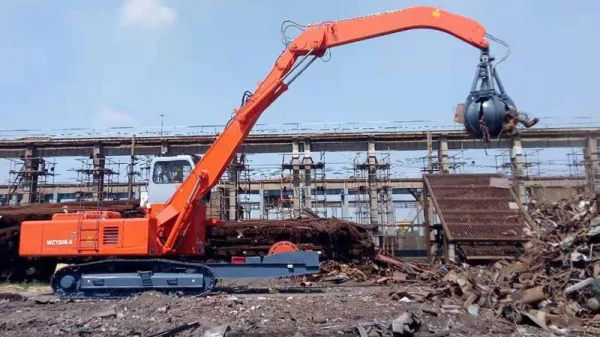
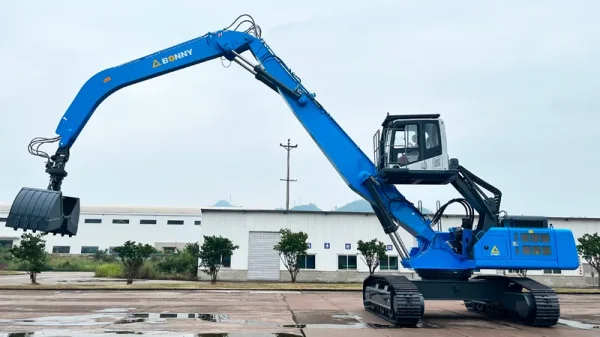
This is a mobile material handler for scrap metal in recycling application.
So, how should you approach the selection process?
The best starting point is to understand the work the machine will actually perform, rather than selecting a model based on its advertised specifications alone.
1. Define Your Material Handling Application First
Before comparing mobile material handlers, take a close look at the materials, working environment and handling process.
This sounds obvious, but it is one of the most important steps in equipment selection. Material characteristics directly influence the required lifting capacity, attachment type, working reach and hydraulic configuration.
For example, handling loose scrap metal is fundamentally different from handling timber, municipal waste or bulk commodities.
1.1 Scrap Metal Recycling
Scrap yards handle a mixture of steel, aluminum, copper, dismantled machinery and processed metal. Materials are often irregular in shape, difficult to grip and distributed across different stockpiles.
A scrap material handler needs:
- Strong lifting performance throughout the working range.
- A durable boom and stick designed for repetitive handling.
- Suitable orange-peel grapples, magnets or sorting attachments.
- Good visibility when loading trucks or sorting material.
- Adequate protection for exposed hydraulic cylinders and vulnerable components.
In this environment, attachment durability and cycle speed are particularly important. A machine that looks powerful on paper may still become a bottleneck if the grapple is poorly matched to the material or the operator cannot position loads accurately.
1.2 Ports and Bulk Material Terminals
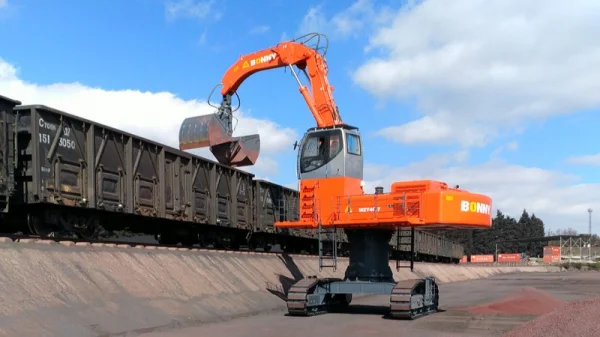
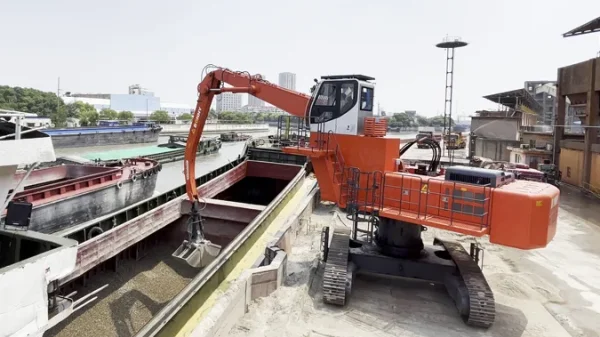
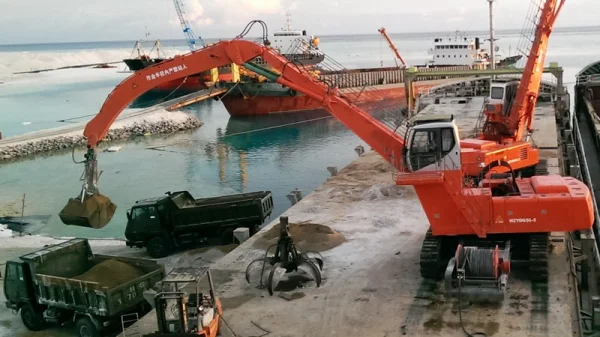
Ports handle materials such as coal, iron ore, aggregates, grain, fertilizer and other bulk commodities. Depending on the facility, a mobile material handler may be used for stockpile management, truck loading, railcar unloading or feeding downstream conveying systems.
The main considerations are different from those of a scrap yard:
- Longer working reach for accessing vessels, barges or large stockpiles.
- Sufficient lifting capacity at the required horizontal and vertical positions.
- Suitable clamshell grabs for loose bulk materials.
- Hydraulic performance for repetitive loading cycles.
- Protection against dust, abrasive material and harsh outdoor conditions.
For bulk cargo, grab capacity alone does not determine productivity. Material density, grab filling efficiency, loading height and the time required to complete each cycle all affect actual throughput.
1.3 Waste and Recycling Facilities
Waste transfer stations and recycling plants often process mixed materials, including construction waste, plastics, paper, wood and bulky refuse.
The operating environment may include uneven surfaces, confined working areas and frequent changes in material type.
A suitable machine should offer good manoeuvrability, attachment flexibility and sufficient structural protection. Visibility is also important, particularly when multiple vehicles and personnel operate within the same facility.
1.4 Timber and Forestry Operations
Timber handling requires a different approach to boom and attachment selection.
Logs are long, heavy and often unevenly distributed. The handler must be able to grip bundles securely, position them accurately and maintain stability during repeated lifting operations.
A dedicated timber grapple and an appropriate boom configuration are generally more useful than simply choosing a larger general-purpose machine.
The practical rule: Define your primary application first, then identify secondary tasks. Buying a machine that can perform ten different jobs is not necessarily a good investment if it is inefficient at the two jobs that account for most of your working hours.
2. Calculate the Required Lifting Capacity and Working Reach
Lifting capacity and working reach are closely related. However, they should never be evaluated separately.
A material handler may advertise an impressive maximum reach, but its lifting capacity decreases as the load moves farther away from the machine. This is why maximum reach is not a reliable indicator of actual working performance.
Start by identifying three dimensions:
- Horizontal working distance: How far must the machine reach from its slewing centre to pick up or place material?
- Vertical working height: Does it need to load high-sided trucks, railcars, hoppers or vessels?
- Working envelope: At which boom positions will the machine spend most of its time?
The third point is often overlooked. A machine may only occasionally operate at maximum reach, while most of its working hours are spent handling material at a medium radius.
The lifting capacity available at this frequently used position is far more relevant to daily productivity.
2.1 Understand the Real Load Being Lifted
Another common mistake is to calculate the required lifting capacity using only the weight of the material.
The total suspended load also includes the attachment and any relevant connecting components. For example:
Total suspended load = Material weight + Attachment weight + Connecting components
Consider a machine equipped with a heavy-duty orange-peel grapple. The grapple itself consumes part of the machine's available lifting capacity before any scrap metal is picked up.
The same principle applies to magnets, clamshell buckets and other handling tools.
When reviewing equipment specifications, request the manufacturer's lifting charts for the exact machine configuration. These should correspond to the selected boom, stick, counterweight, attachment arrangement, undercarriage and stabilizer conditions.
Do not rely on a single maximum lifting figure.
Ask the supplier to demonstrate the available lifting capacity at your actual working radius and lifting height, including the relevant working direction.
2.2 Consider the Complete Material Handling Cycle
A machine with a slightly lower nominal lifting capacity may still deliver better daily output if it has a shorter working cycle and can consistently handle the required load.
For a bulk handling operation, a useful way to estimate productivity is:
Hourly throughput = Average material payload per cycle × Operating cycles per hour × Effective operating factor
For clamshell operations, average payload is influenced by grab volume, bulk density and the actual filling ratio. For scrap handling, load shape and how efficiently the grapple closes around the material are also important.
Use actual site observations whenever possible. A specification sheet cannot fully reproduce the conditions of a real stockpile or loading area.
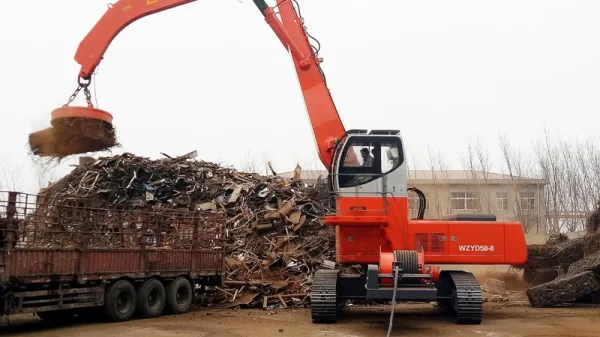
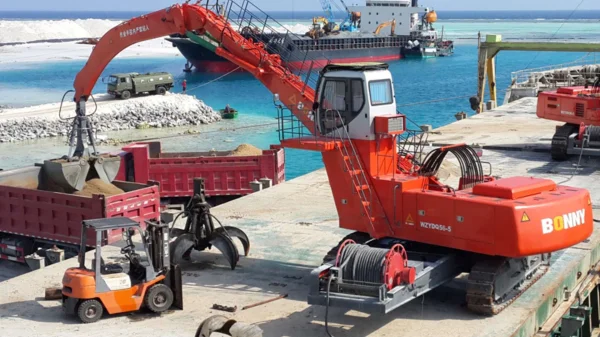
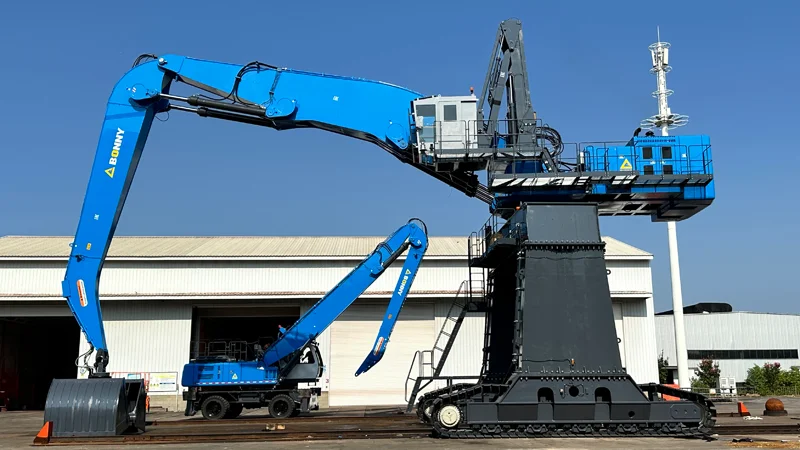
This is a tracked material handler for truck loading.
3. Choose Between Wheeled and Tracked Material Handlers
The undercarriage determines how a mobile material handler moves, how it interacts with the ground and where it can operate efficiently.
Neither wheels nor tracks are universally better. The correct choice depends on the surface conditions, required travel distance, machine mobility and lifting arrangement.
3.1 Wheeled Material Handler
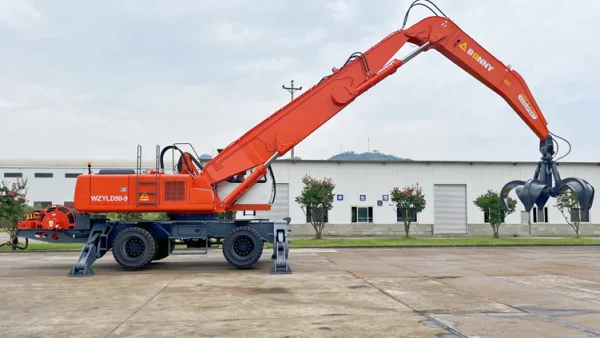
A wheel material handler is generally a practical choice for facilities with firm, reasonably level surfaces, such as paved scrap yards, concrete recycling facilities and established port terminals.
Its main advantages include:
- Faster movement between working positions.
- Good manoeuvrability on suitable surfaces.
- Less disturbance to finished ground surfaces.
- Convenient repositioning around truck loading areas.
- Practical operation where machines frequently travel within a facility.
However, wheel-mounted machines need careful consideration of ground conditions and load stability.
When comparing models, examine axle capacity, tyre specifications, braking performance, stabilizer arrangements and the manufacturer's approved lifting configuration.
If the machine uses outriggers or stabilizers, confirm the required deployment area and the corresponding lifting capacities. Do not assume the same capacity applies with stabilizers raised and lowered.
3.2 Tracked Material Handler
A crawler material handler is generally more suitable for rough, soft or uneven ground.
Tracks distribute the machine's weight over a larger contact area, helping reduce ground pressure and improve mobility where wheeled equipment may struggle.
Common applications include:
- Demolition and construction waste processing.
- Unpaved recycling yards.
- Timber handling areas.
- Stockyards with uneven or soft ground.
- Sites where the machine needs to work close to material piles on variable surfaces.
Tracked configurations also require attention to track width, ground clearance, shoe design, travel resistance and maintenance access.
For particularly demanding applications, an extended or wider undercarriage may be worth considering. Nevertheless, wider tracks do not remove the need for a suitable ground-bearing assessment.
3.3 Wheeled vs. Tracked Material Handler: Which Is Right?
| Selection Factor | Wheeled Material Handler | Tracked Material Handler |
| Operating surface | Concrete, asphalt and firm ground | Soft, rough and uneven terrain |
| Travel speed | Generally faster | Generally slower |
| Manoeuvrability | Suitable for frequent repositioning on firm surfaces | Better suited to working across challenging terrain |
| Ground pressure | Typically higher | Typically lower |
| Maintenance focus | Tyres, axles, brakes and stabilizers | Tracks, rollers, sprockets and undercarriage |
| Typical applications | Scrap yards, transfer stations and paved terminals | Demolition, rough stockyards and unpaved facilities |
There is one more issue to consider: the actual lifting position.
A wheeled material handler may depend on stabilizers to achieve its specified lifting performance. A tracked handler may rely on its undercarriage geometry and the manufacturer's approved working configuration.
Always compare the applicable lifting charts rather than assuming one chassis design offers greater capacity in every situation.
4. Select the Right Boom, Stick and Working Geometry
Boom and stick design influence the working envelope, lifting performance, attachment visibility and suitability for different materials.
A longer boom may provide the reach needed to load high-sided trucks or access a distant stockpile. However, increasing reach can also reduce available lifting capacity and may make the machine less suitable for close-range sorting.
The objective should be to select a boom arrangement that matches the actual loading and unloading positions.
4.1 Straight Boom and Stick
Straight-boom configurations are commonly used where extended reach and material placement are important.
They can be particularly useful for port operations, loading applications and handling material across a wide working area.
4.2 Drop-Nose Configurations
Drop-nose designs can improve the operator's view of the attachment and material, depending on the overall boom geometry.
This can be useful in scrap sorting, waste handling and applications where accurate positioning near the machine is required.
4.3 Heavy-Duty Boom Structures
Scrap handling can expose the boom and stick to repeated shock loads, contact with irregular metal objects and abrasive wear.
In these conditions, structural durability should carry significant weight in the selection process.
Ask about:
- Boom and stick plate thickness and structural design.
- Reinforcement around high-stress areas.
- Cylinder and hose protection.
- Pin and bushing arrangements.
- Inspection and replacement access.
A boom designed for smooth bulk loading should not automatically be assumed suitable for heavy, irregular scrap handling. The machine's intended duty and structural configuration matter.
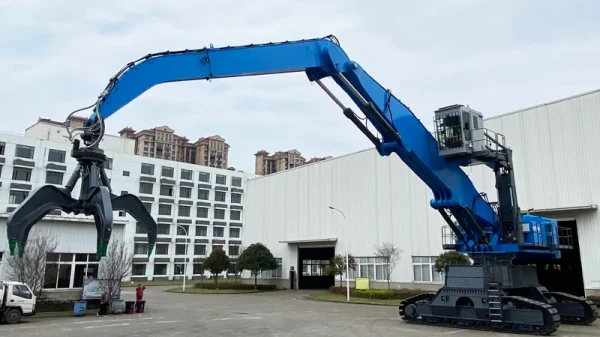
5. Match the Attachment to the Material
The attachment is not simply an accessory added after purchasing the machine. It is part of the working system and should be considered during the initial equipment specification.
An unsuitable attachment can reduce payload, slow the cycle and place unnecessary demands on the hydraulic system.
5.1 Orange-Peel Grapple
Orange-peel grapples are commonly used for loose and irregular scrap metal.
Their multi-tine design allows operators to grip material from different directions, making them suitable for loading and sorting mixed scrap.
5.2 Material Handling Magnet
A hydraulic or electrically powered magnet is used primarily for ferrous materials such as steel and iron.
When specifying a magnet system, check the generator's electrical output, magnet power requirements, cable routing and control integration.
The attachment and machine must be designed as a compatible system, not treated as two independent purchases.
5.3 Clamshell Grab
Clamshell grabs are widely used for loose bulk materials such as coal, grain, aggregates and fertilizer.
Selection depends on:
- Required grab volume.
- Material bulk density.
- Expected filling ratio.
- Hydraulic opening and closing performance.
- Material flow characteristics.
A larger grab does not automatically mean greater productivity. If the machine cannot safely lift the full grab at the required working radius, increasing the grab volume may create more problems than it solves.
5.4 Sorting and Demolition Grapples
These attachments are useful for handling construction debris, concrete, timber and mixed waste.
They offer flexibility where materials need to be separated before further processing.
5.5 Hydraulic Shears
Hydraulic shears are used to cut metal and other suitable materials into smaller sections.
Because shears can impose considerable force and structural loads, the carrier must be specifically approved and configured for the selected attachment.
5.6 Check Hydraulic Compatibility
Before ordering, obtain the attachment manufacturer's requirements for hydraulic pressure, flow rate, return-line configuration and any additional circuits.
Also confirm whether the machine requires a rotation circuit, electrical connections, a dedicated generator or additional control functions.
The attachment should be matched to the machine's hydraulic system and expected duty cycle. Simply confirming that two hydraulic connections are available is not sufficient.
6. Evaluate Cab Design and Operator Visibility
Material handling operators spend much of their working time looking over material piles, inside containers, across truck bodies or toward stockpiles.
Visibility affects both safety and productivity.
A fixed-height cab may be adequate for some applications. However, a rising cab can provide a substantial operational advantage where the operator needs to see over high piles or into large vehicles.
A hydraulic elevating cab allows the operator to work from a higher viewing position when required, while maintaining convenient access at ground level.
When evaluating the cab, look beyond the seat and control layout.
Consider:
- Direct visibility of the attachment.
- Visibility around the machine's rear and sides.
- Camera coverage and blind-spot reduction.
- Cab elevation range.
- Joystick ergonomics and control response.
- Heating, ventilation and air conditioning.
- Noise levels and operator comfort.
- Access and emergency arrangements.
Operator comfort is not merely a convenience. In facilities operating multiple shifts, poor visibility, uncomfortable controls and excessive fatigue can affect consistency throughout the working day.
7. Check Hydraulic Performance, Cooling and Duty Cycle
Material handlers often work through repetitive lifting, slewing, loading and unloading cycles.
A machine that performs well during a short demonstration may behave differently after several hours of continuous operation.
This is where hydraulic system design becomes particularly important.
The hydraulic system must support the boom, stick, slewing mechanism and attachment functions without creating excessive operating temperatures or sluggish response.
During equipment evaluation, ask about:
- Hydraulic flow and pressure: Are the main and auxiliary circuits correctly sized for the selected attachment?
- Cooling capacity: Can the cooling system maintain suitable operating temperatures in the expected ambient conditions and duty cycle?
- Filtration: Are hydraulic filters and service intervals appropriate for dusty or demanding environments?
- Control response: Does the machine provide smooth and predictable movement during combined boom, stick, swing and attachment operations?
- Protection: Are hoses, cylinders and hydraulic components adequately protected against the hazards of the application?
Cooling deserves special attention in recycling yards, ports and dusty industrial facilities. Radiator and oil-cooler surfaces can accumulate dust, fibres and other debris, reducing heat transfer.
Features such as accessible cooling packages, reversible fans and easy-to-clean screens can make a meaningful difference to routine maintenance.
8. Consider Safety and Site Conditions
A mobile material handler is a heavy lifting machine. Its working environment can include suspended loads, moving vehicles, personnel, high stockpiles and restricted working areas.
Safety requirements should therefore be evaluated before the machine is purchased, not after it arrives on site.
Start with the basic lifting conditions.
Confirm that the operating surface can support the machine and that the specified lifting configuration is followed. Ground conditions, slope, stabilizer deployment, load direction and working radius can all influence stability.
Other important areas include:
- Suitable lifting charts and load monitoring where specified.
- Rear-view and around-view camera systems.
- Audible travel alarms and warning lights.
- Emergency stop and control lockout functions.
- Operator protective structures and guarding where required.
- Visibility of personnel and vehicles within the working area.
- Adequate lighting for night operations.
- Clear separation between pedestrian and machine movements.
One practical point should not be ignored: the machine's tail swing.
A large counterweight and rotating upper structure need sufficient clearance. In compact yards, the available swing area may be just as important as maximum boom reach.
A site layout review should account for the machine's full working envelope, material stockpiles, truck positions and pedestrian routes.
Always operate within the manufacturer's approved lifting limits and the site's lifting and traffic management procedures.
9. Compare Total Cost of Ownership, Not Just Purchase Price
The purchase price is only one part of the financial decision.
For equipment expected to operate for many years, operating costs and machine availability can have a greater influence on the overall investment.
A useful comparison should include:
| Cost Category | What to Evaluate |
| Initial purchase | Base machine, boom, cab, counterweight and selected attachments |
| Fuel or electricity | Expected energy consumption under the planned duty cycle |
| Undercarriage | Tyres, brakes, tracks, rollers and related replacement costs |
| Hydraulic system | Filters, oils, hoses, pumps and cylinder maintenance |
| Attachments | Grapple teeth, tines, wear plates, cutting edges and repairs |
| Scheduled servicing | Labour, parts, inspection and maintenance intervals |
| Unplanned downtime | Lost handling capacity and disruption to the site |
| After-sales support | Parts availability, technician response and warranty coverage |
A low-priced machine may become expensive if critical components are difficult to obtain or if the local service network cannot support the operation.
For that reason, ask suppliers about parts availability, service arrangements, technical support and expected maintenance requirements.
It is also worth reviewing whether telematics, remote diagnostics and machine condition monitoring are available. These tools can help maintenance teams identify problems earlier and understand equipment utilization.
The real cost of a material handler should be measured over its working life, not simply by the invoice price.
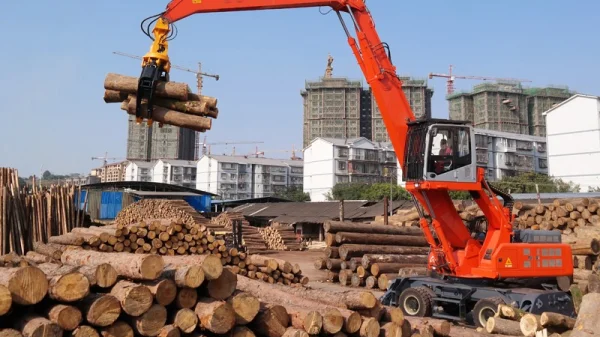
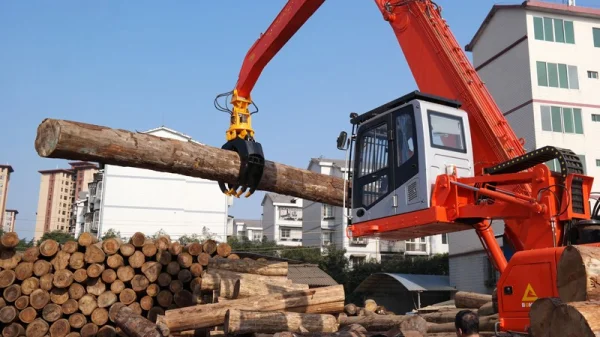
This is a mobile timber handler for sawmill industry.
10. Build a Selection Specification Before Requesting Quotations
Once the application and operating conditions are understood, prepare a basic technical specification for suppliers.
This makes quotations easier to compare and reduces the risk of receiving proposals based on different assumptions.
Your specification should include:
- Application: Scrap handling, port operations, waste recycling, timber handling or another defined task.
- Material: Material type, bulk density where relevant, average load weight and material dimensions.
- Working reach: Required horizontal reach, loading height and typical operating radius.
- Required lifting capacity: Actual material payload plus attachment and connecting components.
- Undercarriage: Wheeled or tracked, based on ground conditions and travelling requirements.
- Boom configuration: Straight boom, drop-nose arrangement or application-specific design.
- Attachment: Grapple, magnet, clamshell, shear or other approved tool.
- Hydraulic requirements: Flow, pressure, rotation circuits and auxiliary functions.
- Cab configuration: Fixed or elevating cab, based on visibility requirements.
- Operating conditions: Working hours, shifts, ambient temperature, dust and site layout.
- Service requirements: Local parts availability, maintenance support and warranty terms.
Whenever possible, provide photographs or a simple site layout showing the machine's intended operating area.
A supplier who understands the actual operation should be able to recommend a suitable configuration and explain why it is appropriate. If a proposal only lists machine weight, engine power and maximum reach, there is not yet enough information to make a sound technical comparison.
11.Final Thoughts: Choose the Machine Around the Work, Not the Specification Sheet
Choosing the right mobile material handler is ultimately a matter of matching machine configuration to real operating conditions.
Start with the material and the handling process. Establish the required working reach and lifting capacity. Select the appropriate wheeled or tracked undercarriage, then match the boom, attachment, hydraulic system and cab configuration to the application.
Finally, compare maintenance requirements, service support and total operating costs.
A well-matched material handler should do more than lift the required load. It should complete the handling cycle efficiently, operate safely within the available space and remain productive under the conditions it was purchased to handle.
That is what makes a machine a good investment: not the biggest specification on a brochure, but the right combination of performance, reliability and operating cost for the work ahead.
- Electric Material Handler for Ports, Scrap & Bulk Handling
- What Is a Material Handler and How Does It Work? Buyer’s Guide
- Best Material Handler Attachments for Scrap Metal, Bulk Materials, and Timber Handling
- Dual Power Material Handler for Ports: Diesel vs Electric Operating Cost
- How to Choose the Right Grab for a Material Handler: Clamshell, Orange Peel, or Magnet
- Mobile Material Handler for Rail Wagon Loading & Unloading

Next: Index Page
Table of Contents

Leading Mobile Bulk Material Handling Equipment Manufacturer in China. A high-tech enterprise specializing in R&D and manufacturing of stacker conveyors, ship loaders, and bucket wheel reclaimers. We provide comprehensive mobile solutions, including mobile hopper feeders, truck unloaders (surface feeders), and transfer conveyors, alongside high-performance mobile crushing and screening plants for global bulk material processing.
How to Contact
- WhatsApp: +8617821512097
- E-mail: [email protected]
-
 Add: China

