
 REQUEST A QUOTE
 EN
EN English
Just let we know what you want, and we will get in touch with you as soon as possible!

Radial Stacker vs Fixed Stacker: Which Stockpiling Solution Is Better
When choosing a stockpiling system for bulk material handling, one of the most common comparisons is radial stacker vs fixed stacker. Both are widely used in mining, quarrying, ports, cement plants, and aggregate handling—but they serve different operational needs.
This guide compares radial stackers and fixed stackers across multiple dimensions, including stockpile capacity, operational flexibility, cost, maintenance, and application suitability, to help you choose the right stockpiling solution for your project.

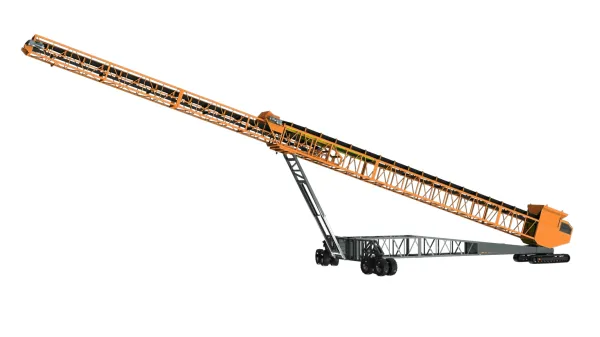
This is a radial telescopic stacker for aggregate plant.
What Is a Radial Stacker?
A radial stacker conveyor is a stockpiling conveyor that rotates around a central pivot point, allowing material to be distributed in a circular or arc-shaped pattern. This rotation enables the formation of larger, more efficient stockpiles without repositioning the conveyor.
Key features of radial stackers:
- Slewing (radial) movement
- Increased stockpile volume
- Reduced loader and dozer usage
- A telescopic structure can be adopted
- Suitable for mobile and semi-mobile systems
Radial stackers are commonly used in aggregate quarries, mining operations, bulk terminals, and portable crushing plants.
What Is a Fixed Stacker?
A fixed stacker conveyor discharges material at a stationary point. Once installed, its discharge position remains unchanged unless structural modifications are made.
Key features of fixed stackers:
- Simple and robust design
- Lower initial capital cost
- Minimal moving components
- Ideal for permanent installations
Fixed stackers are widely used in cement plants, power plants, fertilizer facilities, and continuous-process industries.

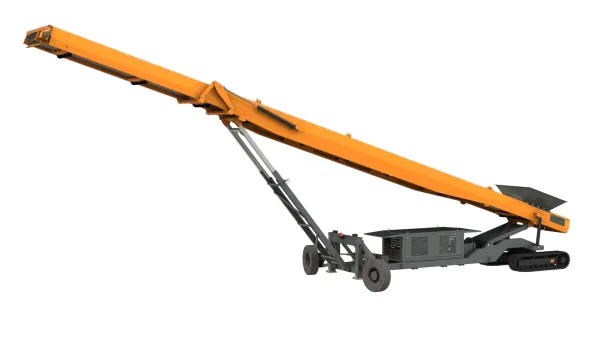
radial telescopic stacker with hydraulic driving tyres
Radial Stacker vs Fixed Stacker: Key Differences
1. Stockpile Capacity and Land Utilization
One of the most important differences between radial and fixed stackers is stockpile efficiency.
- Radial stackers can increase usable stockpile capacity by 30–50% compared to fixed stackers on the same footprint.
- Fixed stackers form cone or ridge piles that reach maximum height quickly and require additional space or rehandling.
For operations with limited land availability, radial stackers offer a clear advantage.
2. Operational Flexibility
Radial stacker conveyors provide superior flexibility:
- Adjustable pile size and shape
- Suitable for multiple materials
- Easy integration with mobile crushers and screens
- Stable, continuous production
- Single-material handling
- Fixed plant layouts
If your operation changes frequently, a radial stacker is the more future-proof option.
3. Loader Dependency and Labor Costs
A major hidden cost in fixed stacker systems is secondary material handling.
- Fixed stackers often require wheel loaders or bulldozers to manage pile growth.
- Radial stackers reduce or eliminate the need for mobile equipment by automatically spreading material.
This leads to:
- Lower fuel consumption
- Reduced labor requirements
- Less material degradation and dust
Over time, these savings can outweigh the higher purchase price of a radial stacker.

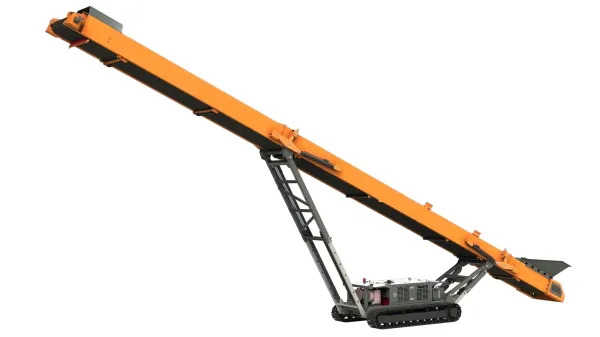
This is a foldable radial stacker for crushing plant and stockyard.
4. Capital Cost vs Operating Cost
From a pure equipment cost perspective:
- Fixed stackers have a lower upfront price
- Radial stackers require additional components such as slew drives and pivot bases
However, when considering total cost of ownership (TCO):
- Radial stackers often deliver lower operating costs
- Reduced loader hours translate into long-term savings
For high-throughput applications, radial stackers are usually more economical over the equipment lifecycle.
5. Maintenance and Reliability
Fixed stackers:
- Fewer mechanical parts
- Lower maintenance complexity
- Easier inspections
Radial stackers:
- Require maintenance of slew bearings and rotation systems
- Slightly higher inspection frequency
Modern radial stackers are designed for heavy-duty use, and with proper maintenance, reliability remains high.
6. Mobility and Expansion Potential
Radial stackers—especially tracked radial stackers and mobile radial conveyors—offer greater mobility and scalability.
They are ideal for:
- Temporary stockpiling
- Expansion projects
- Relocatable crushing and screening plants
Fixed stackers are more suitable for permanent installations with long-term, stable layouts.
7. Environmental and Safety Benefits
Radial stackers can support environmental compliance by:
- Reducing dust caused by rehandling
- Lowering emissions from mobile equipment
- Improving stockpile stability
These advantages are increasingly important in regulated mining and port environments.

radial stacker using truss frame design
Radial Stacker vs Fixed Stacker: Application Comparison
| Application | Recommended Solution |
| Aggregate quarry | Radial stacker |
| Mining stockpiles | Radial stacker |
| Bulk port terminal | Radial stacker |
| Cement plant | Fixed stacker |
| Power plant | Fixed stacker |
| Fertilizer plant | Fixed stacker |
| Mobile crushing plant | Radial stacker |
Which Stockpiling Solution Is Better?
The choice between a radial stacker and a fixed stacker depends on your operational priorities.
Choose a radial stacker conveyor if:
- You need maximum stockpile capacity
- Land availability is limited
- Operational flexibility is critical
- You want to reduce loader dependency
Choose a fixed stacker conveyor if:
- Your process is stable and continuous
- Initial capital cost is the main concern
- The installation is permanent
In many modern bulk handling projects, the question isn't radial stacker vs fixed stacker—it's whether the long-term operational efficiency of a radial stacker justifies the higher upfront investment. More often than not, the answer is yes.
- 800TPH Telescopic Stacking Conveyor
- How to Troubleshoot Mobile Stacking Conveyor Cleaner
- What is Mobile Stacking Conveyor?

Table of Contents

Leading Mobile Bulk Material Handling Equipment Manufacturer in China. A high-tech enterprise specializing in R&D and manufacturing of stacker conveyors, ship loaders, and bucket wheel reclaimers. We provide comprehensive mobile solutions, including mobile hopper feeders, truck unloaders (surface feeders), and transfer conveyors, alongside high-performance mobile crushing and screening plants for global bulk material processing.
How to Contact
- WhatsApp: +8617821512097
- E-mail: [email protected]
-
 Add: China

